
Leadership is often described in terms of vision, direction, and strategic clarity. Those qualities still matter. Yet in practice, leadership performance is increasingly shaped by something more demanding: the ability to make decisions and sustain progress when conditions are volatile, pressured, and rarely clear-cut.
This article draws on Nigel Wright Group’s wider research into business resilience and growth, alongside executive roundtable discussions with senior business leaders. The picture that emerges is one of organisations that are broadly clear on what they need to do. The harder challenge lies in turning that clarity into consistent action when resources are constrained, trade-offs are constant, and certainty is in short supply.
That shift matters because it changes how leadership should be judged. Setting direction remains essential. Increasingly, though, leadership is tested by whether organisations can keep moving when execution becomes harder, decisions become heavier, and the environment refuses to settle.
Key Questions Answered
What are the key challenges facing business leaders today?
Leaders are operating in an environment shaped by persistent uncertainty, tighter resources, repeated trade-offs, and rising pressure to deliver results while conditions continue to shift.
Why is there often a gap between strategy and execution?
Because many organisations are clear on their priorities, but lack the alignment, capacity, and delivery momentum needed to move several major initiatives forward at once.
How are leaders making decisions under uncertainty?
Decision-making is becoming slower, more scrutinised, and more financially disciplined, even as leaders recognise that waiting too long can create strategic risk of its own.
What capabilities matter most in leadership today?
Strategic vision remains important, but it now sits alongside adaptability, empathy, commercial judgement, influence, and the ability to lead through ambiguity.
What should leadership teams take from this?
Effective leadership now depends on making sound decisions, maintaining momentum, and building the organisational conditions that allow strategy to be translated into action.
The challenge is sustaining momentum.
One of the clearest findings from the research is that most organisations do not lack strategic intent. Operational efficiency emerged as the strongest priority over the next three years, followed by market expansion, talent and leadership development, AI and automation, and digital transformation. Growth ambitions are also relatively well defined, with new products and services, partnerships, new markets, and customer experience improvement all featuring prominently in the medium-term agenda.
That matters because it changes the nature of the leadership challenge. In many businesses, the broad direction of travel is already understood. The difficulty lies in building enough organisational alignment, delivery capacity, and follow-through to make progress against multiple priorities at the same time.
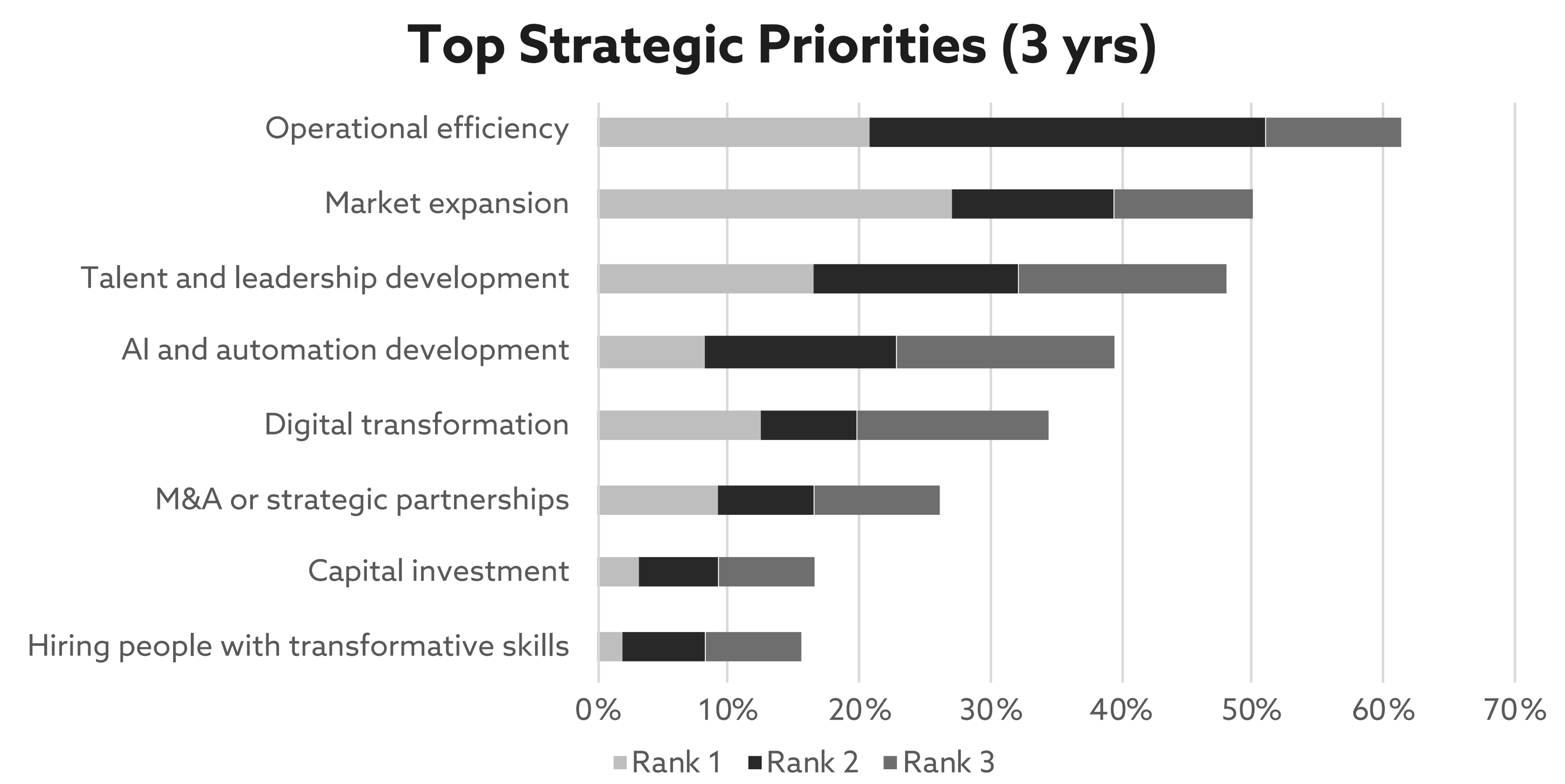
This is where the gap between strategy and results opens up. Transformation slows because execution cuts across people, systems, investment cycles, and leadership attention. Organisations may be trying to improve efficiency, modernise operations, adopt AI, deepen customer relationships, and protect financial performance at the same time. The ambition is there. Execution capacity does not always keep pace.
Many leadership teams will recognise the pattern. Strategic intent remains intact, but progress becomes uneven. Important initiatives advance at different speeds. Near-term pressures crowd out longer-term enablers. What appears to be an execution issue in one area often reflects a wider problem of organisational capacity across the whole system.
Leadership now operates through competing pressures rather than clean choices
The model of leadership built around neat decisions and stable conditions has become less relevant. Senior leaders are increasingly working through pressures that pull in different directions at the same time: growth and profitability, investment and cost control, innovation and risk management, speed and governance. These are becoming a standard feature of leadership itself.
That shift came through strongly in the roundtable discussions. Several contributors described a move away from growth at all costs and towards a stronger focus on profitability as a source of protection. In that environment, decisions that make strategic sense can still be delayed because the financial or market context makes commitment harder. Hiring may be justified. Transformation may be necessary. Investment may be strategically sound. Leadership teams are still being forced to weigh those choices against uncertainty, external pressure, and the cost of poor timing.
This helps explain why leadership now feels more demanding than many traditional models suggest. The challenge is often to choose between options that all carry some downside. Judgement has become more valuable because certainty is rarely available in advance.
Decision-making is changing because the environment has changed
The leaders involved in the discussions were clear that uncertainty has become the context in which decisions are made. Geopolitical instability, economic volatility, regulatory change, and shifting market demand are all influencing the pace, timing, and confidence of organisational decision-making.
That is changing behaviour in measurable ways. Leaders described delayed investment, closer scrutiny of new initiatives, and a stronger reliance on short-term performance indicators. Decisions that might once have moved relatively quickly are now travelling through more challenge, more checks, and more justification. In some businesses, that has encouraged caution. In others, it has sharpened the quality of internal debate.
The more revealing point is that caution itself is now under review. Several participants argued that excessive restraint can become a risk in its own right, particularly in competitive markets where waiting too long can mean lost momentum, missed opportunities, or a weaker response than market conditions require. Leadership, in that context, is increasingly about deciding which risks are worth taking, when to move, and how to create enough confidence around the decision process to act before complete visibility arrives.
This is also why governance and decision quality matter more than ever. In difficult periods, how a decision was made can shape outcomes long after the moment itself. Clear papers, accurate minutes, defined delegated authority, and a reliable record of what was considered all help create discipline when pressure rises.
Leadership capability is being redefined in real time
As the operating environment has changed, so has the profile of effective leadership. Traditional strengths still matter, but they no longer cover the full job. The capability mix emerging from the research is broader, more adaptive, and more demanding than many organisations have historically prioritised.
The most highly valued long-term leadership quality in the research was strategic vision. Close behind were empathy and people leadership, adaptability, and commercial acumen, with influence, digital fluency, and risk management or ethical judgement also ranking as important. That combination is revealing. It points to a version of leadership that depends on setting direction, interpreting ambiguity, bringing others with you, and making sound judgements when the path ahead is still forming.
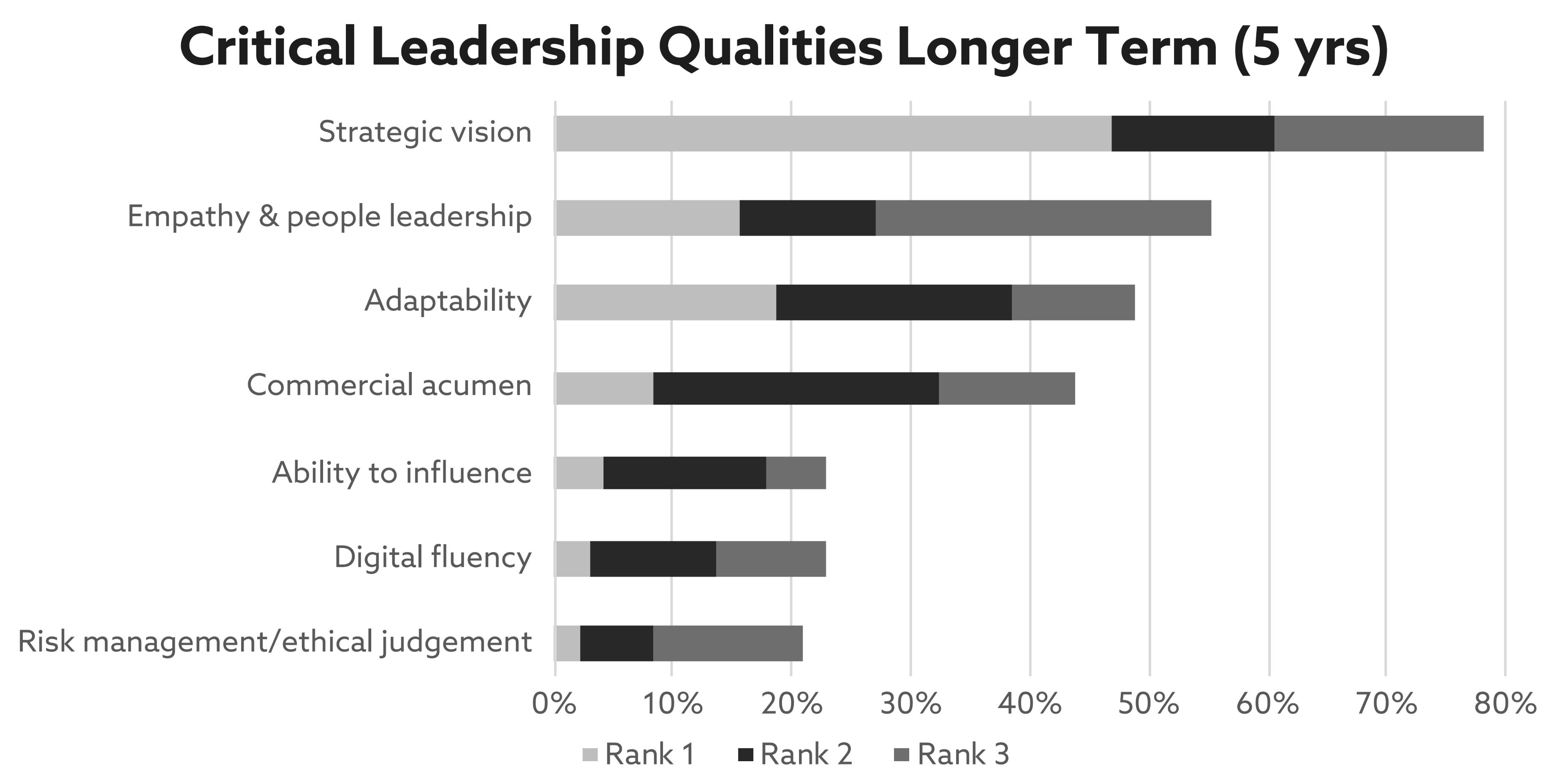
The roundtable comments sharpen that interpretation further. Several participants said hiring priorities are shifting away from narrow technical matches and towards people who can manage change, solve problems in uncertain conditions, and remain effective when roles, markets, or technologies move quickly around them. One participant captured the shift with a useful phrase: “propensity to change.”
That marks a significant evolution in how leadership capability is understood. Experience and subject knowledge remain valuable. Increasingly, though, the leaders who create impact are those who can maintain progress, build confidence, and make intelligent decisions while the organisation itself is under strain. Adaptability has moved from being a desirable trait to a core operational strength.
Leadership still drives change, but delivery depends on the wider system
The discussions made clear that leadership remains central to organisational change. Practical examples included investment in senior roles such as Chief Technology Officers and Heads of Data, where those appointments help translate strategic intent into operational action. In the right context, these hires can create the capability needed to modernise systems, redesign processes, and improve decision quality across the business.
At the same time, the conversations were equally clear on another point: transformation does not succeed because of one appointment alone. Leadership can create direction and momentum, but execution still depends on the surrounding system — people, process, capability, and organisational alignment. When those elements do not move together, progress slows and strategy loses force on contact with the business.
This is where the strongest leadership teams separate themselves. They do more than make decisions. They build the conditions in which decisions can actually be implemented. They create clarity, protect momentum, and prevent strategic priorities from being diluted by competing demands. The value of external input also emerged here. Advisers, non-executive directors, and investor representatives add most value when they understand the business before pressure builds, rather than arriving only once a problem is already visible.
The cost of inaction may be higher than many leaders assume
One of the most useful arguments to come through in the discussions was that inaction can be more dangerous than taking a measured risk. In uncertain conditions, delay often feels responsible. In practice, the cost of delay is rarely neutral. Competitors continue to move. Customer expectations keep shifting. Capability gaps deepen. Opportunities narrow.
Several participants made the case that maintaining investment — particularly in areas such as marketing, leadership capability, or growth-critical functions — can create advantage precisely because other organisations are stepping back. That means leadership teams need frameworks that allow movement without requiring perfect visibility first.
This may be the most important mindset shift of all. Leadership today depends on working effectively in uncertainty rather than waiting for uncertainty to pass. Once volatility is treated as a permanent feature of the landscape, leadership becomes a discipline of building confidence, judgement, and organisational capacity within it.
What business leaders should take from this
The reality of leadership has changed in practical and measurable ways. Leadership is defined by the ability to make decisions, sustain progress, and convert intent into action when conditions keep changing and trade-offs cannot be avoided.
For leadership teams, that creates several clear implications. First, decision-making frameworks need to evolve. Faster, clearer, and more flexible processes are becoming essential if organisations are going to move with confidence in uncertain conditions. Second, leadership capability should be treated as a strategic priority in its own right. Strategic vision, adaptability, empathy, commercial judgement, and influence now sit close to the centre of performance. Third, organisations need to build execution capacity more deliberately, recognising that strategy only creates value when the surrounding system can carry it forward.
Leaders also need to rethink the relationship between caution and decisiveness. The issue is no longer choosing one or the other. The task is to act with discipline, using strong judgement and governance while keeping enough momentum to avoid drift.
Leadership, therefore, should now be understood as a continuous process of adaptation. As markets shift, the way decisions are made, communicated, and implemented has to shift with them. The effectiveness of leadership is measured less by the absence of uncertainty and more by the ability to work through it with clarity, confidence, and control.
Download the full report
This article is drawn from Nigel Wright Group’s wider research into business resilience and growth, alongside executive roundtable discussions with senior business leaders. To explore the full findings, broader market themes, and strategic implications in more detail, download the full report.
Building Resilient Growth Report
This report is based on Nigel Wright Group’s market research across the North of England, examining attitudes to business resilience and growth strategies at the start of 2026.
By submitting your details, you have read and understood our Privacy Notice