
In many organisations, productivity is increasingly being improved by redesigning how work is done. Workforce restructuring has moved beyond being a reactive response to pressure. It is becoming one of the main ways leadership teams are trying to improve performance, strengthen resilience, and build operating models that can cope with tighter resources, rising expectations, and more complex delivery demands.
This article draws on Nigel Wright Group’s wider research into business resilience and growth, alongside executive roundtable discussions with senior business leaders. The picture that emerges is clear: workforce restructuring is increasingly being used to improve productivity, support growth, and create organisations that are easier to manage, quicker to respond, and better aligned with current operating realities.
That shift matters because it changes how restructuring should be understood. The real issue is whether the organisation can redesign roles, processes, systems, and accountability in ways that improve output without quietly weakening capability. In that sense, restructuring is becoming less about reduction alone and more about redesign.
Key Questions Answered
How are organisations restructuring their workforce to improve productivity?
By redesigning roles, flattening hierarchies, increasing cross-functional working, and reshaping the operating model so work can be delivered with greater clarity and less duplication.
What role does automation play in workforce redesign?
Automation is helping reduce manual and repetitive work, but it is only one part of a wider productivity strategy built around better process design, stronger systems, and clearer role definition.
How can businesses balance efficiency with capability?
They need to improve productivity without stripping out the skills, experience, and capacity required to sustain delivery, customer outcomes, and future growth.
What are the risks associated with restructuring?
If handled badly, it can reduce morale, weaken service delivery, increase pressure on remaining teams, and remove critical organisational knowledge faster than the business can replace it.
Leaner structures are being used to improve performance
One of the clearest themes in the discussions was the move towards leaner organisational structures. Leadership teams described a shift away from layered management models and complex reporting lines, and towards structures designed to improve agility, reduce duplication, and respond more quickly to changing conditions.
Several pressures are driving that change. Financial constraints are increasing the need for cost control. Talent shortages are limiting the ability to scale through headcount alone. At the same time, speed and responsiveness have become more commercially important. Together, those pressures are forcing organisations to think differently about where value is created, how work is organised, and what kind of structure is best suited to delivery.
The research suggests that workforce redesign is already well advanced. Nearly half of respondents said their organisation is redesigning roles, making it the most common workforce change under way. Around 40% reported creating new roles focused on transformation, roughly 38% said they were flattening hierarchies or restructuring teams, and a similar proportion said they were increasing reliance on cross-functional teams. Close to a quarter are shifting towards more project-based teams, while only around one in five said they had observed no significant changes.
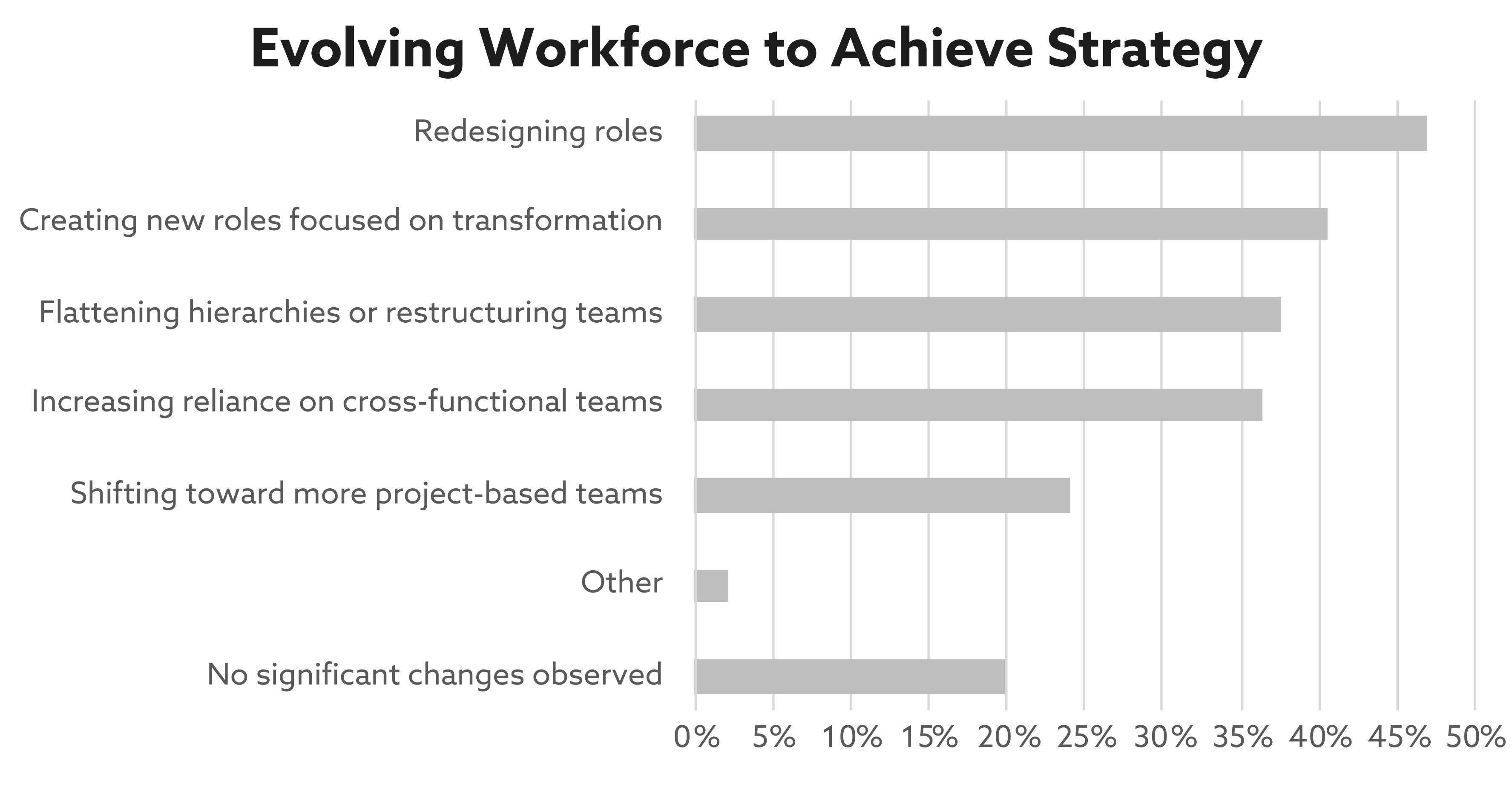
These findings suggest that leaner structures are being used to improve clarity, remove duplication, and create organisations that can respond more quickly under pressure. Even so, leaders were clear that leaner structures must still support delivery. Reducing headcount without redesigning process can simply transfer pressure to the remaining workforce and create new performance risks rather than solve them.
Automation is becoming part of the productivity mix
Technology is now playing a more central role in how organisations think about productivity. Across the discussions, leaders described growing use of automation to reduce manual workload, especially in administrative and transactional processes. Examples included automating repetitive back-office work, using AI to support customer service and communications, and implementing systems that reduce reliance on manual data entry.
In one example, contributors described document-processing technologies that had significantly reduced time spent on routine tasks. Elsewhere, organisations are using AI to improve access to information, allowing frontline teams to respond more quickly and accurately without repeated internal escalation. These examples point to a broader shift in how productivity is being improved. Increasingly, gains are coming from better systems and smarter process design rather than simply from more people.
The wider research supports that direction. Around 20% of respondents identified AI or automation to reduce dependency on hard-to-fill roles as one of the more effective strategies for addressing workforce pressure. That is lower than upskilling or flexible working, which suggests automation is not yet the dominant response. Even so, it is becoming an increasingly important part of the response.
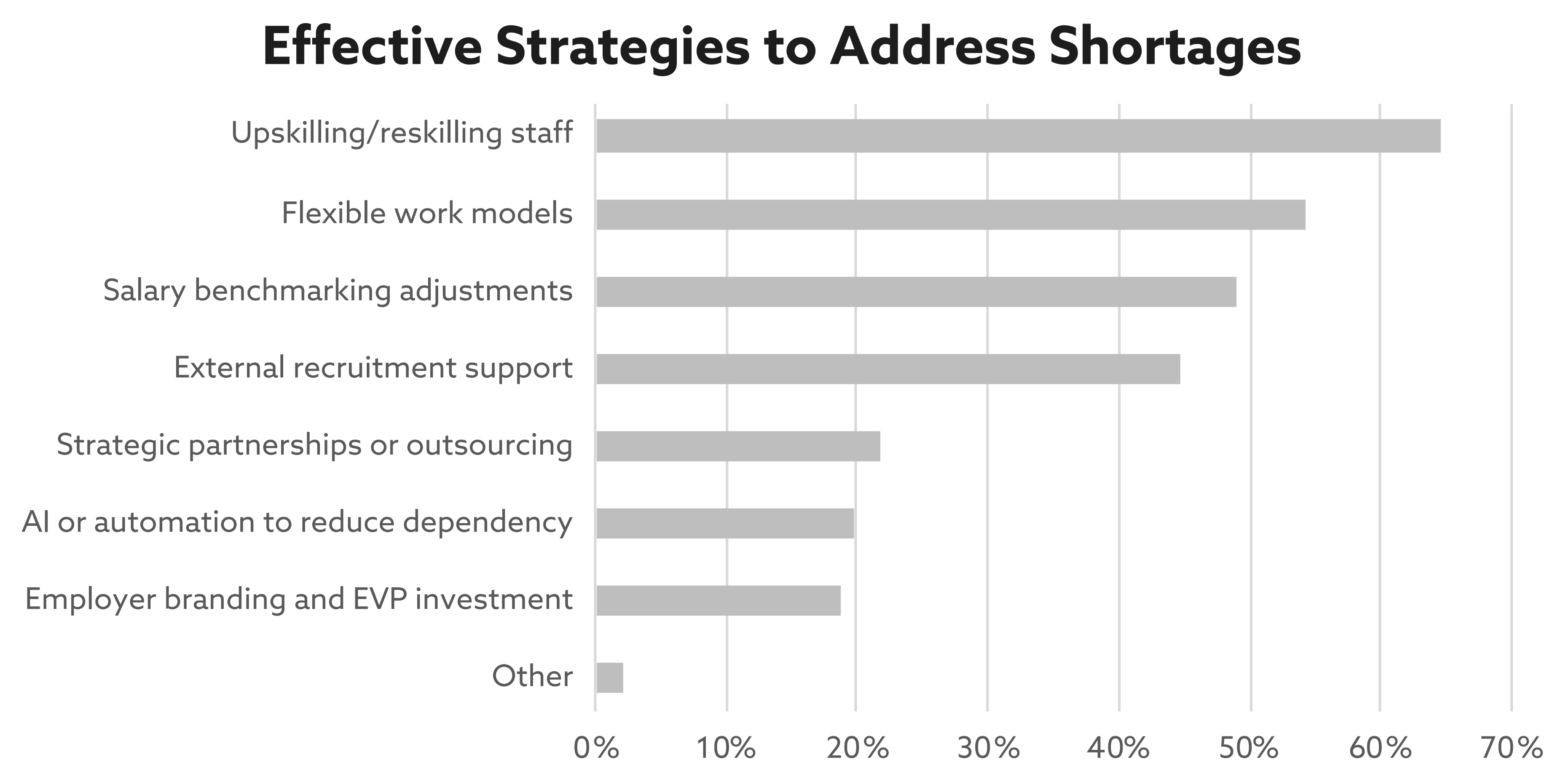
That matters because it points to a more realistic model of performance improvement. Automation can reduce friction and improve efficiency, but sustainable productivity gains still depend on redesigning processes, clarifying workflows, and making sure technology is integrated into the wider operating model. In other words, automation works best as a complement to redesign, not as a substitute for it.
Role redesign is changing what organisations need from people
Workforce restructuring is also reshaping the role itself. Participants described a move away from narrowly defined job descriptions and towards broader, more flexible roles that combine multiple responsibilities. This is being driven by both necessity and opportunity. As automation removes some routine tasks, employees are being asked to take on more value-added work and to operate more effectively across functions or systems.
That shift is showing up in practical ways. Operational roles are increasingly combining digital and analytical capability. Customer-facing roles often require broader commercial awareness. Leadership roles are expanding to include transformation and change responsibilities. The prevalence of role redesign in the research suggests that many organisations are redefining what they need from each role and building more fluid operating models around those changes.
This can create real benefits. Broader roles can improve flexibility, increase responsiveness, and reduce duplication. They can also make it easier for organisations to deploy talent where it creates the most value. But there is a clear risk as well. People need the skills, support, and clarity required to perform effectively in more complex roles. Without that investment, role expansion stops being productive and starts becoming a source of overload.
Productivity and headcount no longer move in lockstep
One of the most important themes in the discussions was the weakening relationship between productivity and workforce size. Historically, increasing output often meant increasing headcount. That assumption is now much less reliable. Organisations are finding ways to deliver more with fewer people, improve output through better process and technology, and focus more on quality and effectiveness than on simple volume.
The research suggests that, for many businesses, productivity is already improving relative to the pre-pandemic baseline. Around 37% of respondents said productivity is slightly higher than in 2020, while a further 29% said it is significantly higher. Around 25% reported productivity as about the same, and only a small minority — roughly 8% — said it is slightly lower.
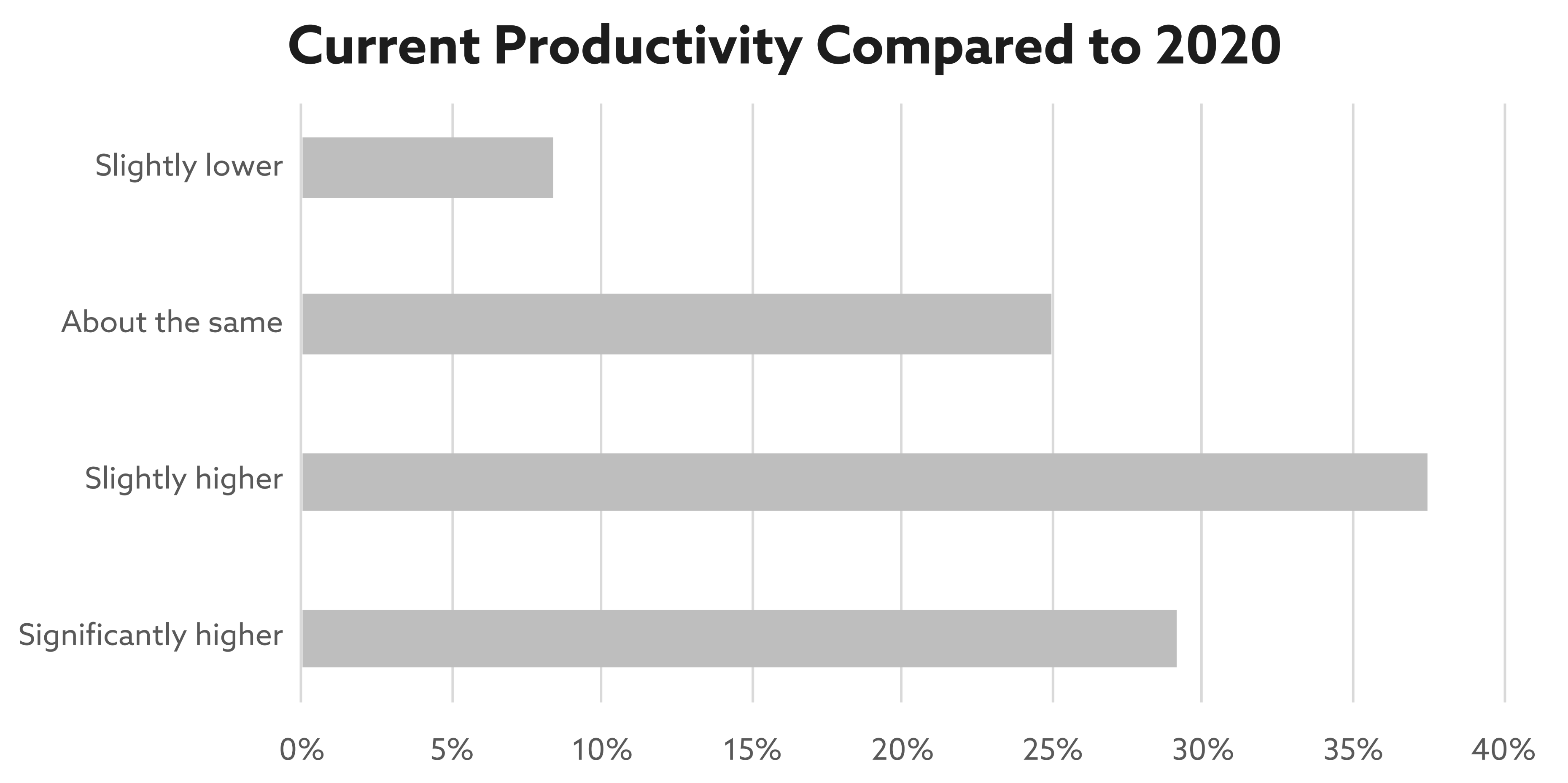
Best placed here because it gives direct evidence for one of the article’s central arguments: that better output is increasingly being achieved through redesign, systems, and capability rather than headcount growth alone.
Those findings are significant. They suggest that most organisations are seeing at least some productivity improvement despite talent shortages and cost pressure. At the same time, they do not imply that headcount has become irrelevant. The relationship is simply more complex than before. Output now depends more heavily on process design, digital enablement, and workforce capability than on workforce size alone. Leaders also cautioned that reducing headcount without improving underlying processes can still damage performance. Sustainable productivity gains need to come from structural improvement rather than cost reduction in isolation.
The risks of restructuring rise when redesign is rushed or badly handled
Restructuring can create clear benefits, but the discussions also highlighted the risks that come with it. Participants pointed to loss of organisational knowledge, reduced employee morale and engagement, increased pressure on remaining teams, and disruption to service delivery. Those risks become more acute when restructuring is implemented quickly, communicated badly, or disconnected from the realities of day-to-day delivery.
Several contributors argued that workforce redesign is never just an operational decision. It is also a leadership challenge. Changes work best when they are clearly communicated, aligned with strategy, and backed by the right resources and attention. Where role changes, headcount reductions, or terms and conditions are involved, process matters. Redundancy, consultation, performance management, and discrimination risks all need to be handled with care. Communication has to build trust rather than amplify uncertainty.
This is why restructuring has to be judged by more than short-term savings. If it weakens capability, reduces trust, or damages the customer experience, then the gains may prove temporary. The best redesigns are the ones that improve efficiency while preserving the organisation’s ability to perform.
Restructuring works best when it is aligned with strategy
A key insight from the discussions was that workforce restructuring becomes more effective when it is tied directly to broader organisational priorities. The strongest examples were organisations integrating workforce decisions into growth strategy, financial planning, and wider transformation agendas rather than treating them as isolated people initiatives.
That matters because restructuring that is disconnected from strategy may produce short-term savings while quietly weakening long-term capability. By contrast, organisations that consider people, process, and technology together are more likely to build operating models that support both efficiency and resilience. The research supports that integrated view. The prominence of role redesign, transformation-focused hiring, flatter structures, and cross-functional teams suggests that many workforce decisions are now being shaped by strategic priorities rather than cost considerations alone.
The broader implication is that restructuring is becoming part of strategic operating model design. It is less about periodic downsizing and more about continuously aligning workforce shape, skills, and systems with what the business needs to deliver.
Leadership determines whether workforce redesign succeeds
Leadership plays a central role in successful restructuring. Participants repeatedly emphasised the need for clear direction, consistent communication, alignment across leadership teams, and continued engagement with employees. Leaders need to balance the drive for efficiency with the need to preserve capability and morale. That balancing act requires judgement, credibility, and a clear rationale for change.
The strongest outcomes are more likely when leaders explain why change is needed, what it means for individuals, and how the organisation will support people through the transition. In that sense, restructuring is also a test of leadership trust and organisational confidence. It is one thing to design a leaner model on paper. It is another to carry people through the changes needed to make it work in practice.
That is why workforce redesign should be seen as an ongoing leadership discipline that sits at the intersection of productivity, capability, and trust.
What business leaders should take from this
The wider lesson is that workforce restructuring is becoming a more permanent feature of organisational strategy. It reflects a shift in how businesses think about productivity, capability, and performance under pressure. Improving productivity now requires more than reducing cost. It requires redesigning how work is done, including roles, systems, workflows, and leadership accountability.
For leadership teams, several priorities follow. Technology and automation need to be integrated carefully so they strengthen rather than disrupt capability. Workforce decisions need to align with long-term strategy, balancing efficiency with the need to preserve critical skills and capacity. And restructuring itself needs to be understood as an ongoing process rather than a one-off event. As conditions change, organisations will need to keep adapting so that their workforce remains aligned with business priorities.
Productivity, therefore, is increasingly a reflection of how effectively the organisation has been designed to deliver its strategy.
Download the Full Report
This article draws on Nigel Wright Group’s wider research into business resilience and growth, alongside executive roundtable discussions with senior business leaders. To explore the full findings, broader market themes, and strategic implications in more detail, download the full report.
Building Resilient Growth Report
This report is based on Nigel Wright Group’s market research across the North of England, examining attitudes to business resilience and growth strategies at the start of 2026.

By submitting your details, you have read and understood our Privacy Notice