
Growth, digital transformation, customer experience, and operational efficiency are already well-established priorities across leadership teams. The harder problem is what happens next. In many businesses, strategy moves faster than the organisation’s ability to carry it through. Plans are clear and ambition is real, but delivery becomes harder once priorities collide with stretched teams, fragmented systems, limited capacity, and an operating environment that keeps changing.
This article draws on Nigel Wright Group’s wider research into business resilience and growth, alongside executive roundtable discussions with senior business leaders. In most cases, organisations have a reasonable sense of where they need to go. The gap opens later, between plan and performance, ambition and coordination, intention and organisational follow-through.
Delivery capability is therefore becoming one of the clearest sources of competitive advantage. In markets where many organisations are pursuing similar priorities, the difference increasingly lies in whether they can translate strategy into coordinated action with enough focus, pace, and discipline to make change stick.
Key Questions Answered
Why do organisations struggle to execute strategy effectively?
Because strategic intent often exceeds delivery capacity, especially where structures are complex, ownership is unclear, priorities are crowded, and capability is stretched.
What are the main barriers to execution?
Organisational complexity, talent shortages, fragmented systems, overloaded priority lists, and weak coordination all slow implementation.
How can businesses improve execution capability?
By sharpening prioritisation, simplifying structures, clarifying accountability, investing in key delivery roles, and aligning workforce strategy more closely with long-term objectives.
What role does leadership play in driving delivery?
Leadership matters most when it turns strategic intent into coordinated action through clearer ownership, stronger communication, better organisational design, and a more realistic view of capacity.
Strategy is rarely the problem
Leadership teams are generally clear on the broad direction of travel. Growth, stronger customer outcomes, operational efficiency, and technology-led modernisation are already well established across many organisations. As one participant put it, “we know what we need to do… the challenge is execution.” The quality of the strategy often exceeds the organisation’s ability to deliver it.
The breakdown tends to happen when broad ambition meets fragmented systems, crowded priorities, unclear ownership, stretched teams, and limited delivery capacity. Implementation can no longer be treated as the later-stage mechanics of strategy. If the organisation cannot absorb change at the pace the strategy demands, delivery risk must form part of the strategic discussion from the outset.
Complexity slows organisations down in ways leaders often underestimate
Organisational complexity emerged as one of the biggest barriers to progress during the discussions. As businesses grow, they accumulate layered structures, fragmented processes, and systems built for earlier stages of development rather than current delivery demands. Those arrangements may once have supported scale, but over time they create friction, dilute accountability, and slow decision-making.
Participants described a familiar pattern: misalignment between functions, unclear ownership of key initiatives, and dependence on legacy systems and processes. Once those conditions take hold, momentum slows for reasons that are not always obvious at board level. Work becomes harder to coordinate, dependencies multiply, and accountability weakens in the spaces between teams.
Implementation often feels slower than the strategy assumes because of this structural drag. The organisation is trying to move using delivery mechanisms that are no longer suited to the pace, complexity, or interdependence of the change being asked of it.
Capability gaps are now one of the biggest delivery risks
Implementation is deeply shaped by organisational capacity. Talent pressure is no longer a narrow recruitment issue sitting off to one side of the business. It affects whether organisations can deliver strategy, adopt technology, respond to customers, and keep change programmes moving with enough pace.
The research shows that talent shortages are being felt across the organisation rather than in one isolated layer. The pressure is especially visible in the roles that connect strategy to delivery. Mid-level management and technical specialist positions stand out as particular pressure points, with wider shortages also visible at senior, executive, and entry level.
That mix matters because implementation depends heavily on those middle layers and specialist capabilities. These are the people who translate priorities into operational work, coordinate change, and make systems, data, and transformation function in practice.
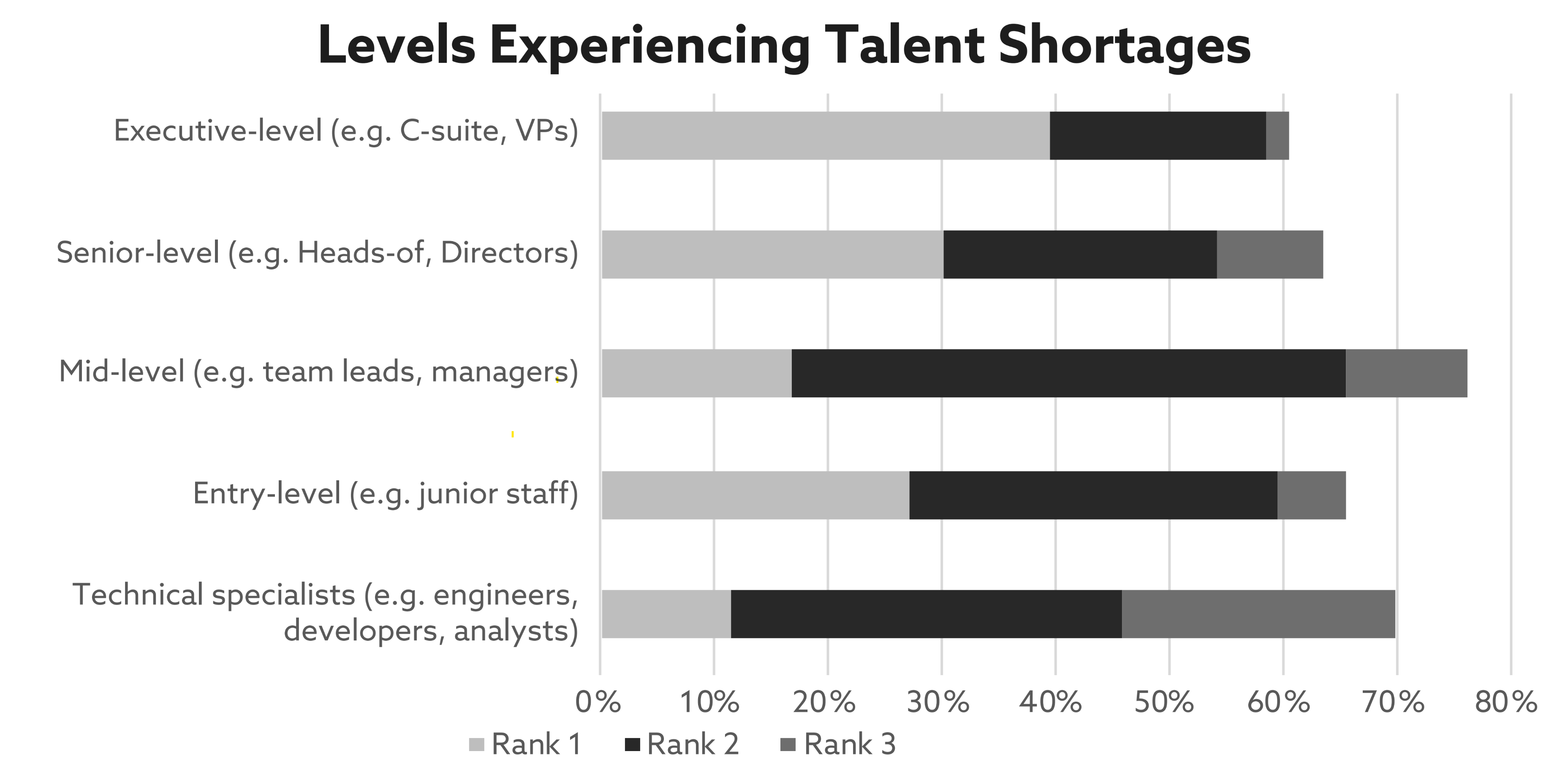
The consequences are practical. Boards may align around priorities, while senior leaders support the direction. Yet progress can still slow quickly if the organisation lacks enough capable managers, digital specialists, analysts, or transformation-focused professionals to carry the work forward.
The roundtable examples sharpened this point. Liam Rafferty, Managing Director of Power Tool World, described the difficulty of finding a leader who was both commercially and technically strong enough to lead digital change. Rather than waiting for an ideal candidate who might never appear, the business split the responsibility across two roles.
Estelle Blanks of Newcastle University described using interim innovation capability to test a model before committing to a permanent structure. Both examples show organisations redesigning delivery capability in real time because the labour market no longer provides simple answers.
Better delivery depends on broader workforce strategy
Stronger implementation often depends on a wider workforce strategy rather than faster recruitment alone. The research points to upskilling and reskilling as the most effective response to shortages, followed by flexible work models, salary benchmarking adjustments, and external recruitment support. Strategic partnerships, outsourcing, AI, automation, and employer branding also play a role, but less prominently.
Seen in this light, delivery risk cannot be addressed by replacing people role by role and hoping outcomes improve. If the real bottlenecks sit in mid-level leadership, technical capability, and transformation positions, organisations need to decide which skills will matter most over the next three to five years.
They must then determine whether those capabilities should be hired, developed internally, brought in on an interim basis, or delivered through external partners.
Traditional recruitment briefs are also starting to look outdated. Several contributors emphasised the growing importance of judgement, resilience, adaptability, and the ability to lead through uncertainty.
A technically strong candidate may still struggle if that person cannot operate in ambiguity, influence others, or help the organisation move through change without losing momentum. Delivery strength now depends as much on behavioural fit and change-readiness as it does on technical competence.
Too many priorities can weaken delivery, even when each one makes sense
Delivery is also weakened by the number of priorities organisations are trying to manage at once. Leaders described businesses expected to deliver growth, control costs, invest in technology, improve customer experience, and respond to external uncertainty, often using the same leadership attention, capital, and talent base.
Fragmentation follows when focus is spread too thinly. Progress may be made across several fronts, but the impact is diluted. One participant made the point directly: organisations can reach a stage where multiple initiatives are all strategically important, but the business has no clear basis for deciding which deserves precedence.
When that happens, results suffer because prioritisation itself has not become disciplined enough.
Strong follow-through depends on more than energy or ambition. It requires sharper choices about where time, investment, and leadership attention should be concentrated, as well as an honest assessment of what the organisation can realistically deliver at the same time.
Leadership matters most when it turns strategy into coordinated action
Leadership behaviour remains central to delivery. The discussions repeatedly returned to the importance of clear accountability, consistent communication, and alignment between teams and objectives.
Organisations making better progress in transformation were often those that had invested in roles focused explicitly on implementation. These included Heads of Transformation, senior technology leaders, and other positions designed to connect strategy and delivery more directly.
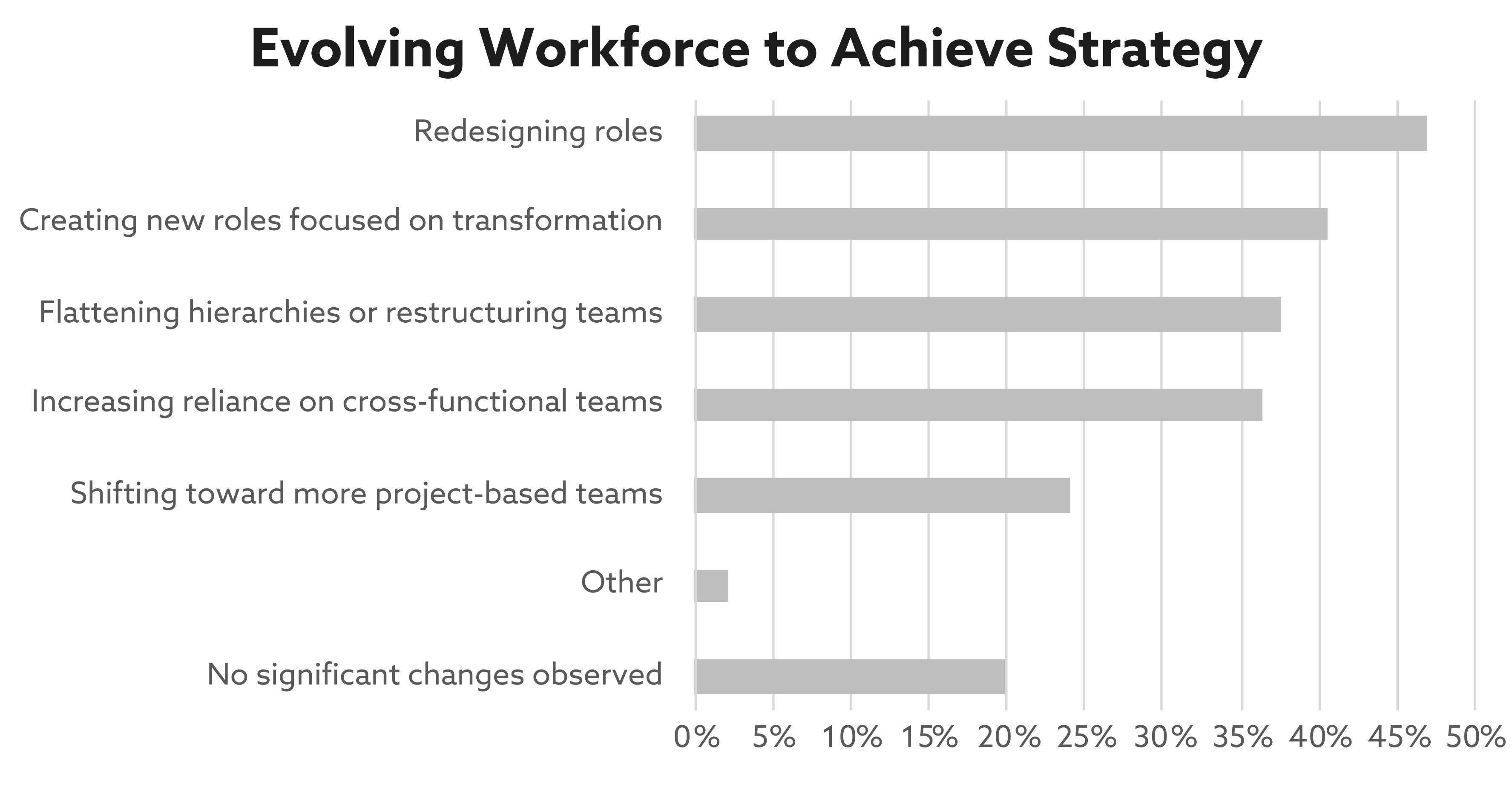
The research points in the same direction. Many organisations are already evolving their workforce to support strategy by redesigning roles, introducing new transformation-focused positions, flattening hierarchies, and making greater use of cross-functional teams.
This marks a shift in how delivery is understood. It is increasingly being treated as an organisational design issue rather than simply a matter of individual performance.
Leaders improve implementation by creating structures, roles, and working practices that make coordinated action more likely. Where those structures are strong, strategy gathers pace. Where they are weak, even good plans can stall.
Closing the gap between plan and performance requires more realism
The roundtable discussions also showed that outcomes improve when organisations become more realistic about what their structures and capabilities can support.
Participants described several practical steps: simplifying structures and processes, clarifying ownership, aligning resources more closely with strategic priorities, and investing in capability, particularly in digital and transformation-focused roles.
Overly ambitious plans create their own problems when the organisation does not have the capacity to deliver them. Several contributors argued for focusing on fewer initiatives and executing them well, rather than trying to move everything at once and achieving only partial impact.
A clearer delivery framework also matters. Defined decision rights, realistic milestones, and visible accountability platforms make it easier to keep moving without losing control. The goal is to improve the quality of implementation so that effort translates more reliably into progress.
What business leaders should take from this
Implementation has become one of the most important practical tests of leadership and one of the clearest sources of competitive advantage.
In markets where many organisations are pursuing similar goals, the businesses that move ahead are often those that translate intent into coordinated action more effectively than others.
For leadership teams, several priorities follow. First, leaders need to assess whether the organisation has the capacity and structure to deliver the strategy effectively. Strategic intent without delivery capability is not enough.
Second, prioritisation needs to become much sharper. The gap often opens because the organisation tries to pursue too many priorities at once with limited capacity.
Third, investment in people remains critical, particularly in the mid-level, technical, and transformation-focused roles that connect strategy to implementation. Delivery strength depends heavily on the layers beneath senior leadership.
Execution should also be treated as an ongoing discipline rather than the final stage of planning. Success depends on sustained focus, organisational alignment, and the ability to adjust as conditions change. The organisations most likely to succeed will be those that can turn intent into results more consistently than their competitors.
Download the full report
The findings explored here form part of Nigel Wright Group’s wider research into business resilience and growth, supported by executive roundtable discussions with senior business leaders.
Download the full report to explore the broader market themes, research findings, and strategic implications in more detail.
Building Resilient Growth Report
This report is based on Nigel Wright Group’s market research across the North of England, examining attitudes to business resilience and growth strategies at the start of 2026.

By submitting your details, you have read and understood our Privacy Notice