
In many organisations, the real limit on growth and change is capacity. Businesses may have a clear sense of where they want to go, but that ambition can only be realised if they have the people, capability, and leadership depth to support it. Across sectors, talent pressure is becoming one of the most serious constraints on business performance because it affects not just hiring, but execution, resilience, succession, and the organisation’s ability to absorb change.
This article draws on Nigel Wright Group’s wider research into business resilience and growth, alongside executive roundtable discussions with senior business leaders. The picture that emerges is clear: talent pressure is influencing how much can realistically be delivered, how quickly transformation can happen, and how confidently leaders can plan for future growth. In many cases, ambition is being constrained less by market opportunity than by the organisation’s ability to support it.
That is why talent pressure now matters in a different way. The central question is whether they can build enough capacity in the right places to deliver strategy, protect leadership pipelines, and sustain performance in a more competitive and resource-constrained market.
Key Questions Answered
Why are organisations facing increasing talent pressure?
Because shortages are now structural across multiple role levels, while demand for capability is rising faster than supply in a more complex operating environment.
How do talent shortages impact growth and performance?
They delay projects, weaken execution, slow transformation, and reduce leadership confidence in the organisation’s ability to scale.
What strategies are companies using to attract and retain talent?
Most are combining upskilling, flexible working, salary benchmarking, external recruitment support, and selected outsourcing or automation rather than relying on one response alone.
How can organisations build capacity in a constrained market?
They need a broader playbook that combines hiring, retention, internal development, workforce redesign, and more deliberate alignment between talent strategy and business priorities.
Talent pressure is no longer cyclical
One of the clearest messages from the discussions was that talent pressure is no longer being experienced as a short-term issue. Leaders described a labour market where demand for skilled individuals continues to outstrip supply, specialist capability remains scarce, and competition for talent stays intense even when the wider economy softens. In other words, the pressure has become a more persistent feature of the operating environment.
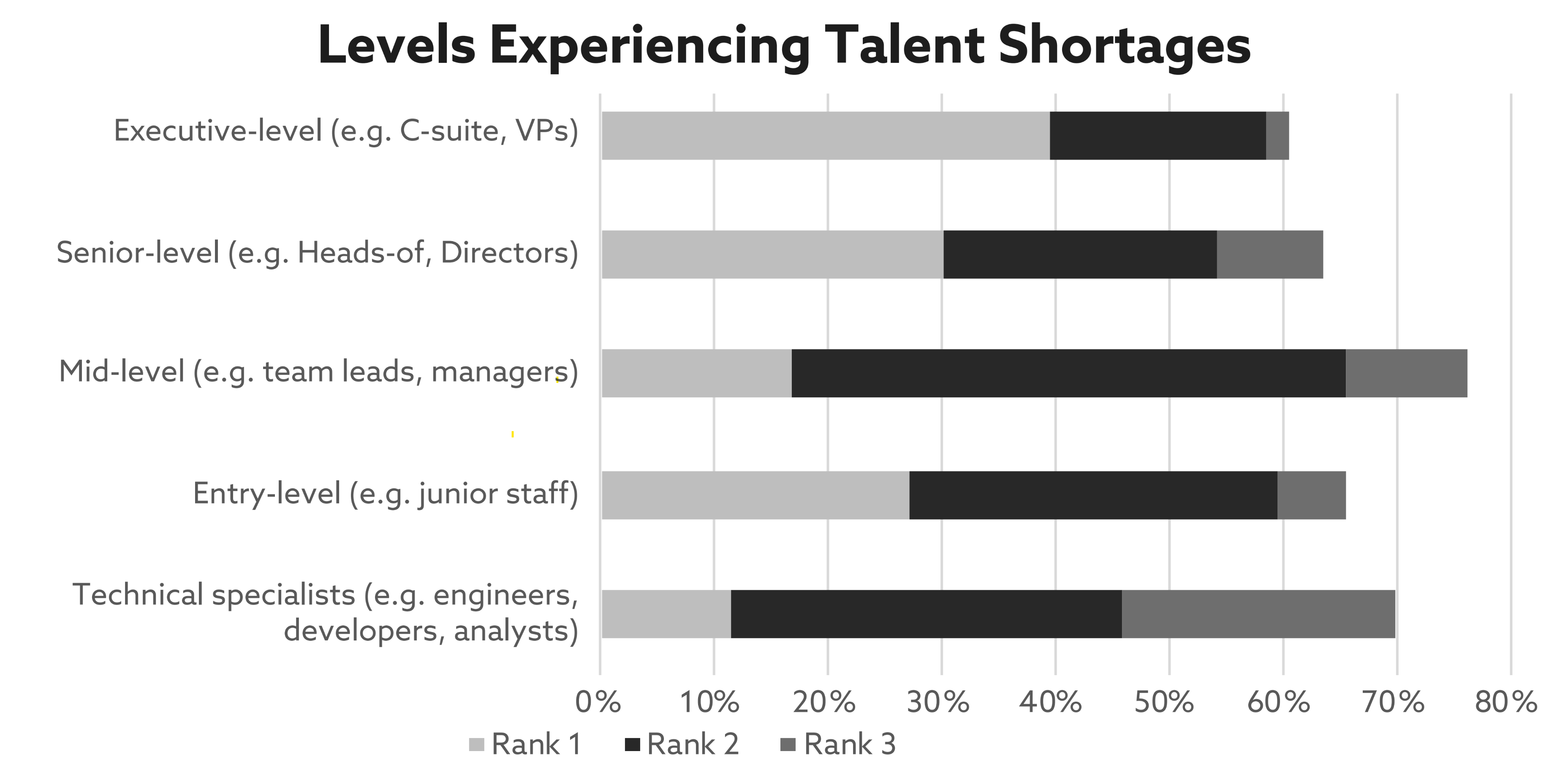
The data supports that view. Shortages are visible across every level of the organisation rather than in one isolated part of the workforce. Mid-level roles are the most constrained, followed by technical specialists, with clear pressure also visible at entry, senior, and executive level. That matters because the issue affects delivery, supervision, succession, and the strength of future leadership pipelines at the same time.
Several contributors made the same point in practical terms. Market demand may rise and fall, but the underlying shortage of capability does not disappear. That leaves organisations dealing with a persistent constraint rather than a temporary fluctuation. Talent strategy, in that context, has to become long-term and proactive rather than reactive.
Capacity is now one of the biggest barriers to execution
The connection between talent and organisational capacity came through strongly in the roundtables. Leaders described strategies that could not be fully delivered because teams lacked the resource, capability, or bandwidth to execute them. The evidence suggests that shortages are most acute in the roles that translate leadership intent into operational action. Mid-level managers are under pressure at the same time as technical specialists, which matters because those are the layers that connect strategic direction to implementation.
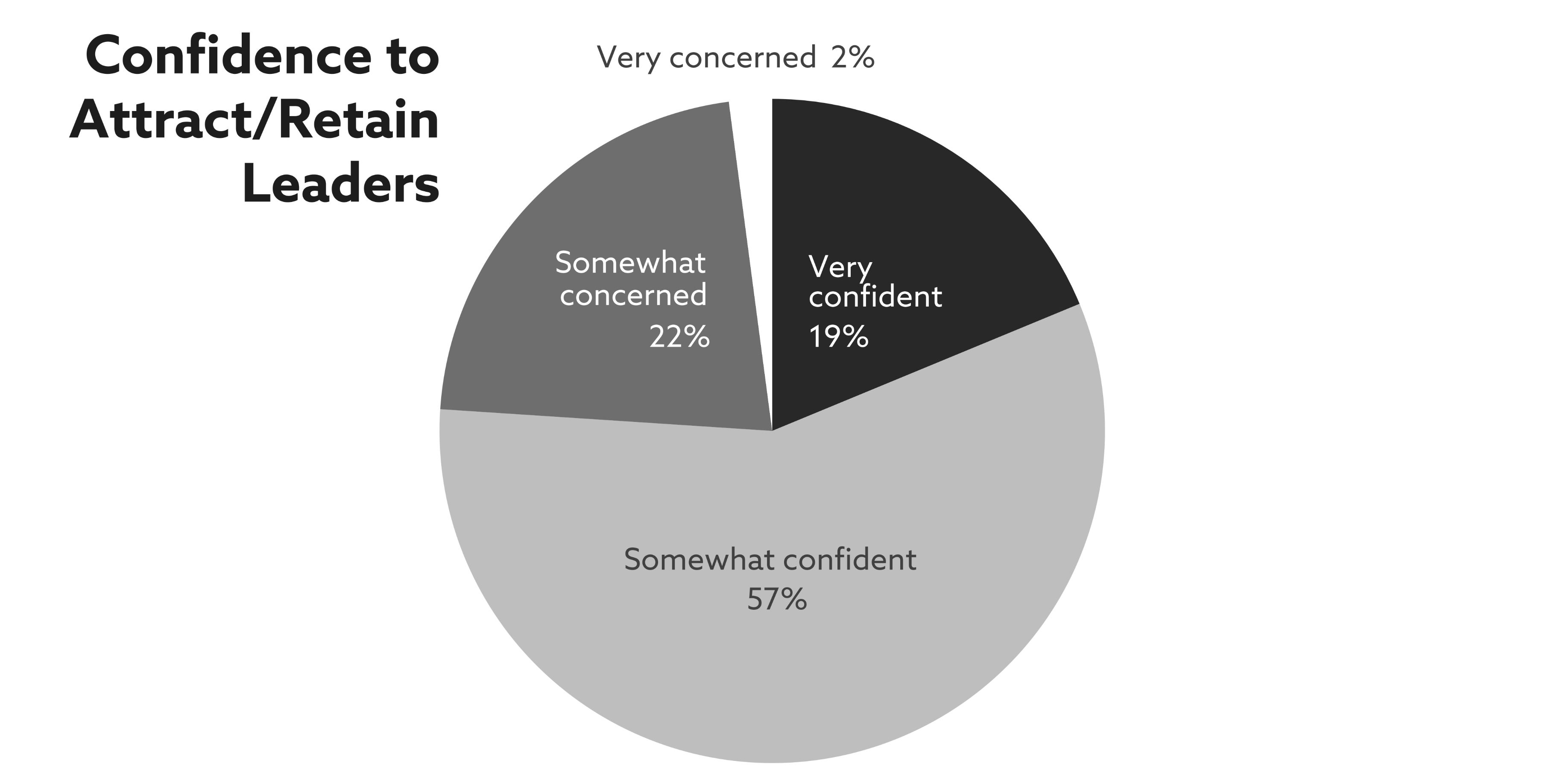
Leadership confidence adds another layer to the issue. Only 19% of respondents said they were very confident in their ability to attract and retain the leadership talent required for future growth. A further 57% said they were somewhat confident, while 22% were somewhat concerned and 2% were very concerned. That does not point to immediate collapse, but it does suggest that many organisations are planning with less certainty about future leadership strength than they would ideally like.
Day to day, talent constraints affect performance in familiar ways. Projects are delayed because critical expertise is unavailable. Change programmes lose momentum when managers lack capacity. Digital and AI investments underperform when the right systems, data, and leadership capability are missing. Growth opportunities go unrealised because too few people can assess and act on them quickly enough.
The strongest examples in the discussions were examples of organisations adapting roles, using interim support, and building more insight-led capability where traditional role profiles no longer matched the market. That is an important distinction. Recruitment now has to start with business design. Leaders need to ask which roles carry the greatest execution risk, which capabilities will matter most in the next phase of growth, and where current structures rely too heavily on a small number of individuals.
Recruiting for future capability requires a broader playbook
Attracting talent remains difficult, but the nature of the challenge is shifting. The question is whether that person can help the organisation adapt to what comes next. Participants described a highly competitive hiring market for roles linked to digital transformation, data and analytics, operational leadership, customer experience, and AI or automation. That competition drives salaries up, stretches hiring timelines, and makes reactive recruitment less effective. It also means that hiring decisions need to become more informed, more forward-looking, and more closely tied to strategy.
The research points to a broad mix of responses already in use. Upskilling and reskilling staff is the most common strategy, followed by flexible work models, salary benchmarking adjustments, and external recruitment support. Strategic partnerships or outsourcing, AI or automation to reduce dependency on hard-to-fill roles, and employer branding or EVP investment are also part of the toolkit, though used less often.
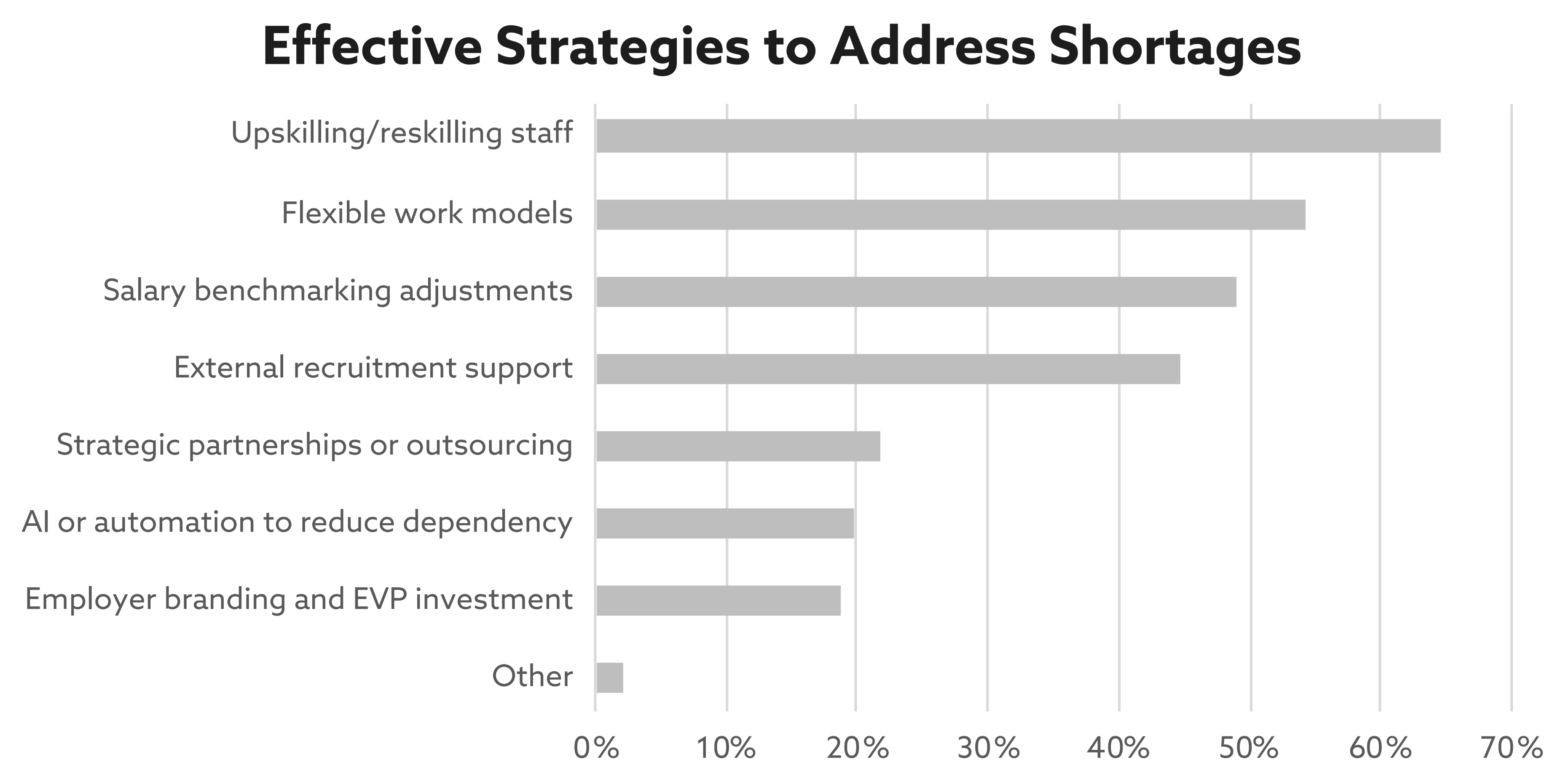
The wider lesson is that no single response is enough. Upskilling takes time. External hiring depends on supply. Pay adjustments add to cost pressure. Automation depends on data quality, governance, and leadership confidence. In practice, organisations need a blended talent strategy that combines internal development, external search, interim support, succession planning, and workforce redesign. Some may also need to look beyond local labour markets, particularly where remote hiring, global teams, or overseas recruitment form part of the answer.
Retention now matters as much as attraction
The roundtables were equally clear that hiring alone will not solve the problem. In a constrained labour market, losing experienced people can have a disproportionate effect on performance. Replacing capability is not always straightforward, particularly where specialist knowledge, trusted relationships, or deep organisational context are involved. In some cases, losing strong people can damage delivery more quickly than failing to add new ones, especially where critical capability is already concentrated in a small number of individuals.
Leaders described greater focus on employee engagement, career development, organisational culture, and clearer communication from leadership. These factors matter because they help preserve stability and reduce avoidable loss of capability. Retention, in that sense, is closely tied to leadership behaviour. Employees are more likely to stay engaged in organisations where leadership is clear, consistent, visible, and supportive during periods of uncertainty or change.
Retention planning also needs to be practical. Succession planning, development pathways, culture, incentives, and a clearer long-term proposition all help reduce dependence on a small number of critical people. Sarah Tahamtani of Clarion reinforced this point by highlighting the value of showing people the longer-term plan, understanding future retirement timelines, and creating reasons for high-quality problem-solvers and relationship-builders to stay.
Internal development is becoming a more important part of the answer
Given the difficulty of external hiring, many organisations are placing greater emphasis on developing talent internally. Participants described upskilling programmes, leadership development, cross-functional training, and structured internal progression routes. These approaches allow organisations to build capability over time while reducing dependence on external markets. They also align with the wider evidence showing that upskilling and reskilling is now the most widely used response to talent shortages.
That said, internal development requires sustained investment, management attention, and time. This is especially true where the organisation needs advanced or specialist capability quickly. As a result, most organisations are balancing internal development with more targeted external hiring rather than choosing one route alone.
The implication is important. Capacity-building cannot be treated as a short-term fix. It has to become part of how leadership teams think about future capability, succession risk, and business resilience.
Transformation is reshaping what capability looks like
Technology and operating model change are increasing demand for new types of capability. As organisations adopt new systems, redesign processes, and push further into digital transformation, they are also reshaping roles and redefining what capability looks like. Demand is rising for people who can lead transformation, interpret and apply data, operate across functions, and stay effective in changing environments.
The research shows that many businesses are already redesigning the workforce in response. Redesigning roles is the most common change. Creating new roles focused on transformation follows closely behind. Flattening hierarchies, restructuring teams, and increasing reliance on cross-functional working are also significant. A meaningful minority are shifting towards more project-based teams, while only around one in five say they have observed no significant workforce changes at all.
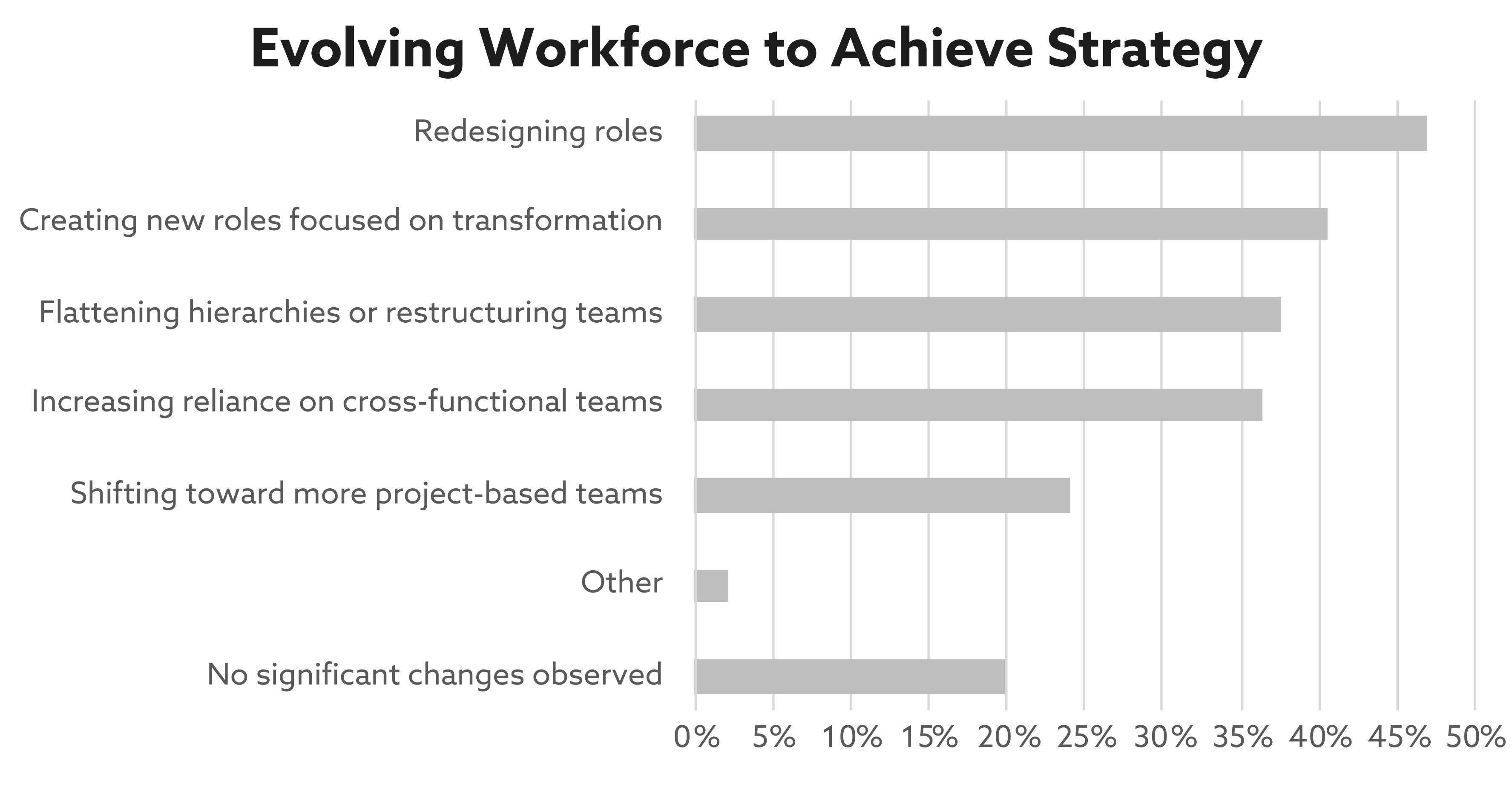
This is an important development because it shows that the response to talent pressure is not confined to recruitment. Many organisations are changing how work is structured, how accountability is distributed, and how capability is deployed. Talent strategy is becoming much more tightly linked to organisational design.
The harder challenge is balancing efficiency with capability
A recurring tension across the discussions was the balance between controlling cost and maintaining capability. As financial pressure increases, many organisations are paying closer attention to efficiency and cost management. Yet reducing headcount or limiting hiring can also weaken capacity and constrain future growth. Leaders described the challenge of protecting short-term financial performance without quietly undermining long-term capability.
That requires a more deliberate approach to workforce planning. Leaders need to decide which roles are essential to future growth, where efficiency can be achieved safely, and how workforce strategy connects to broader organisational priorities. This is why talent has become a strategic issue rather than a purely operational one. The question is whether the business has the right capability in the right places to deliver its priorities.
What business leaders should take from this
The wider lesson from the roundtables is that talent is now one of the most important drivers of organisational performance. It shapes execution, growth capacity, operating resilience, and the organisation’s ability to adapt under pressure. The issue is whether they can build and protect enough capacity to deliver what the strategy demands.
For leadership teams, several priorities follow. Talent strategy needs to be treated as a core component of business strategy rather than a supporting function. Organisations need a balanced approach that combines external hiring with internal development, recognising that sustainable capability cannot be built through either route alone. Leadership plays a central role in attracting and retaining talent through culture, communication, visibility, and consistency. Above all, organisations need to recognise that capacity is finite. Strategic ambition only becomes real when the business has the people, structure, and capability to execute it.
The organisations most likely to succeed will be those that align their talent strategy with their strategic ambitions and build enough capacity to deliver in an increasingly competitive and resource-constrained market.
Download the Full Report
This article draws on Nigel Wright Group’s wider research into business resilience and growth, alongside executive roundtable discussions with senior business leaders. To explore the full findings, broader market themes, and strategic implications in more detail, download the full report.
Building Resilient Growth Report
This report is based on Nigel Wright Group’s market research across the North of England, examining attitudes to business resilience and growth strategies at the start of 2026.

By submitting your details, you have read and understood our Privacy Notice