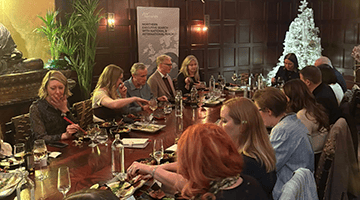

If a strategic workforce plan does not change a decision, it is just a report. That challenge shaped our recent roundtable for senior HR, talent and people leaders in Manchester, where the group examined how organisations can plan their workforce when the future is hard to predict.
The event, Strategic Workforce Planning in an Uncertain Era, took place on Friday 20 November 2026 at Tattu in Hardman Square. Caroline Osler, Fractional Chief People Officer and Executive Coach, led the discussion. Josh Holmes, Senior Consultant at Nigel Wright Group, hosted the afternoon.
Over lunch, attendees discussed how to move from headcount budgeting to strategic workforce planning, how to make the plan create value and what AI means for the process. The discussion ran under the Chatham House Rule, so attendee contributions are not attributed.
Why annual headcount budgeting falls short
Annual headcount budgeting shows a business what it can afford next year. Strategic workforce planning shows it which capabilities it will need to deliver its strategy, where those people will come from and what happens if they cannot be found.
Caroline opened with an example from her career as a Chief People Officer in aviation. Each summer, the airline’s pilot department built a resource plan for the following season and fed it into the budget. For two seasons, pilot supply fell short while demand surged, putting the operation under severe strain. The parent group recruited around a quarter of the subsidiary’s pilots to fly its larger aircraft. Newly promoted captains, each of whom had taken six months and roughly £50,000 to train, were leaving within a year.
Her response was a five-year strategic workforce plan built in Excel. It overlaid company strategy, including lead times for new aircraft, with where pilots would come from and the capabilities they gained at each career stage, from first officer to training captain and manager.
Discussions with senior leaders that had centred on cost began to focus on workforce risk and capability. Two further lessons emerged as the approach spread across the airline:
- One plan does not fit a whole organisation. Each technical area has its own talent supply and capability needs.
- A plan needs an owner and regular use. Without both, it becomes a model that sits on a shelf.
What stops organisations making the shift
A show of hands suggested many in the room had already started moving away from annual headcount budgeting. Breakout discussions showed the remaining barriers relate to definition, time horizons, funding and leadership mindset.
Workforce planning means different things to different people
Attendees agreed that their organisations lacked a shared definition. One organisation is building a common vocabulary based on three tiers:
- Strategic workforce planning, looking three to five years ahead at the differentiating capabilities the business will need and may not yet have
- Operational workforce planning, covering the next 12 to 18 months
- Capacity planning, such as staffing levels in contact centres
Clear terms stop colleagues assuming workforce planning means short-term capacity.
The right time horizon depends on the business
A three-to-five-year horizon suits some organisations and fails others. Start-ups need shorter cycles, while pharmaceutical businesses often plan further ahead than most. One attendee’s organisation produces a five-year plan and reviews it at least once a year, because it relies on a large flexible workforce and operates in an unpredictable market.
Funding and leadership habits hold plans back
A leader from the charity sector explained how dependence on external funding makes long-term planning difficult. Small teams have little room to flex, and growing talent internally pays back only over several years. Leaders asked which skills they will need in five years often cannot say.
One group concluded that organisations need budgeting and strategic planning working together, with leaders encouraged to look beyond next year’s roles.
Transparency helped one organisation make progress. Finance, HR and operations reviewed a three-year business plan together with every department present. Open discussion about how budgets were allocated proved a game changer, and the organisation moved to a three-year planning cycle.
How to make a strategic workforce plan create value
A strategic workforce plan creates value when it answers questions the executive team already cares about and shapes real decisions.
Caroline advised starting with a clear view of where the business is heading. Where the board has only a one-year plan, or none, HR leaders should push for one and draw on what exists, such as the chief financial officer’s outlook. A polished strategy is not a prerequisite.
In the airline, a balanced scorecard helped prove the case. Pilot shortages damaged cost, customer operations, revenue and engagement, as understaffing put pressure on existing colleagues. A strong workforce plan could improve all four results.
Securing time and resource for a first plan can be the hardest step. Caroline recommended quantifying the cost and risk of doing nothing, borrowing analysts from elsewhere in the business and starting with a single area. The plan should address what executives are worried about. Otherwise it risks becoming a cottage industry within HR.
The decisions a plan should shape
Attendees identified several decisions a strategic workforce plan should influence:
- Investment and change programme budgets
- Early careers and talent pipelines
- Redeployment, so a large organisation avoids making people redundant in one area while hiring for the same skills elsewhere
- Succession planning, development and progression
- How and where to adopt AI
One example showed the practical effect. With a full picture of its workforce and capabilities, an organisation can tell finance how many electricians it will need in 2027 and see which employees are two qualifications from the next role. Leaders can then choose how to close the gap: buy, build or borrow talent, expand early careers routes or recruit through prison leaver programmes.
Skills-based planning takes patience
One organisation has based its approach on skills. Work began in 2022, and by early 2026 every role in the organisation had been mapped. Its development catalogue now links to that skills framework, which helps employees see where their skills could take them internally.
Employees saw their transferable skills almost immediately, while the wider return is expected over three to four years. With limited budget, the organisation built the framework itself through tests and trials. Its advice: choose pilot teams carefully so they become sponsors.
Harder questions remain
Executives often struggle to picture roles that do not yet exist, which makes investing in future skills difficult. Listed businesses face tension between quarterly results and long-term planning. One attendee asked whether the workforce that made a business successful will take it forward. Separating people from the roles they hold makes that question especially hard.
Who should own the strategic workforce plan
Strategic workforce planning works best when HR holds the pen and finance, operations and senior leaders contribute directly.
Attendees described a sequence in which business strategy feeds the finance plan, the finance plan feeds the workforce plan and the workforce plan informs recruitment. When each function works alone, the result is separate documents that never connect.
A successful plan needs someone who understands the strategy, someone with strong data skills who will keep the model current, and colleagues who know the day-to-day operation. One leader described HR business partners who sat too far from the strategy to keep a plan up to date.
Another organisation has HR running workshops with finance, capacity planners and senior leaders, supported by shared planning software that reduces manual work and builds confidence in the numbers.
Most attendees saw the plan as one part of the HR strategy mix. In a veterinary business that could not recruit enough vets, the clinical talent programme effectively became the business strategy, showing how stability, seasonality and growth stage shape its role.
How AI is changing strategic workforce planning
AI ran through the whole discussion. Attendees agreed that HR needs a strong voice in each organisation’s AI debate to shape the workforce plan that follows.
Several themes emerged:
- Early careers. Technology change is squeezing entry-level roles, which raises the question of how organisations will develop future senior leaders.
- Generalists and specialists. AI may make many roles more generalist and technical roles more specialised. Some attendees already see blended roles combining chief people officer and chief technology officer responsibilities.
- Growing talent internally. With every employer competing for the same skills, several attendees saw apprenticeships and internal development as essential.
- Recruitment. Some businesses have stopped screening CVs because so many are written with AI tools, and now invite candidates to interview directly.
Key takeaways
- Start with one area of the business and the questions executives already care about.
- To secure time and resource, quantify the cost and risk of not planning.
- Match the planning horizon to the business and review the plan regularly.
- Put finance, operations and HR in the same room, with one person holding the pen.
- Give HR a seat in AI discussions, because AI decisions reshape future workforce needs.
Continuing the conversation
Our thanks go to Caroline Osler for leading such a practical discussion and to every attendee for sharing their experience so openly.
Josh Holmes recruits interim and permanent mid-to-senior HR, talent acquisition and learning and development professionals across the North West. If you would like to discuss a hiring requirement in these areas, or hear about future Nigel Wright Group events, please get in touch with Josh.