
Growth has not disappeared from the corporate agenda. What has changed is the context in which growth now has to be delivered. Across many organisations, ambition remains intact. Leaders still want to expand, improve performance, and create new sources of value. They are doing so, however, in an environment shaped by slower demand, tighter financial conditions, higher operating costs, and greater scrutiny of every major decision. In that context, growth has become more deliberate, more selective, and more demanding.
This article draws on Nigel Wright Group’s wider research into business resilience and growth, alongside executive roundtable discussions with senior business leaders. The picture that emerges is one where organisations are still pursuing growth, but they are doing so through sharper prioritisation, more focused investment, and a stronger emphasis on differentiation, execution, and customer value.
That shift matters because it changes what good growth strategy looks like in practice. In a low-growth environment, businesses are less able to rely on favourable market conditions to carry them forward. Growth has to be built more intentionally through better choices, stronger offers, clearer positioning, and more consistent execution.
Key Questions Answered
How can businesses grow in a low-growth environment?
By combining selective investment, clearer differentiation, stronger execution, and a sharper focus on customer value rather than relying on market momentum alone.
What strategies are organisations using to drive growth?
Most are using several levers at once, including product and service innovation, partnerships, market expansion, and customer experience improvement.
How are leaders balancing growth with financial constraints?
They are pursuing growth more cautiously, with tighter prioritisation, more scrutiny of investment, and a stronger emphasis on managing risk without drifting into inaction.
What are the risks of not investing in growth?
Repeated delay can narrow strategic options, weaken capability, and leave organisations less competitive later, even if caution appears sensible in the short term.
Growth is still possible — but it has become harder won
One of the clearest themes from the discussions was that growth is becoming harder to achieve. Leaders described a market shaped by limited demand, stronger competition, rising customer expectations, and higher operating costs. In that environment, growth has to be won through sharper execution, stronger positioning, and more deliberate strategic choices.
The research reflects that shift clearly. Over the next three years, the most widely identified growth opportunity is the development of new products and services. Strategic partnerships and M&A also feature strongly, followed by new markets and improvements in customer experience. That mix is important because it shows that organisations are trying to combine several levers at once, often in carefully judged ways.
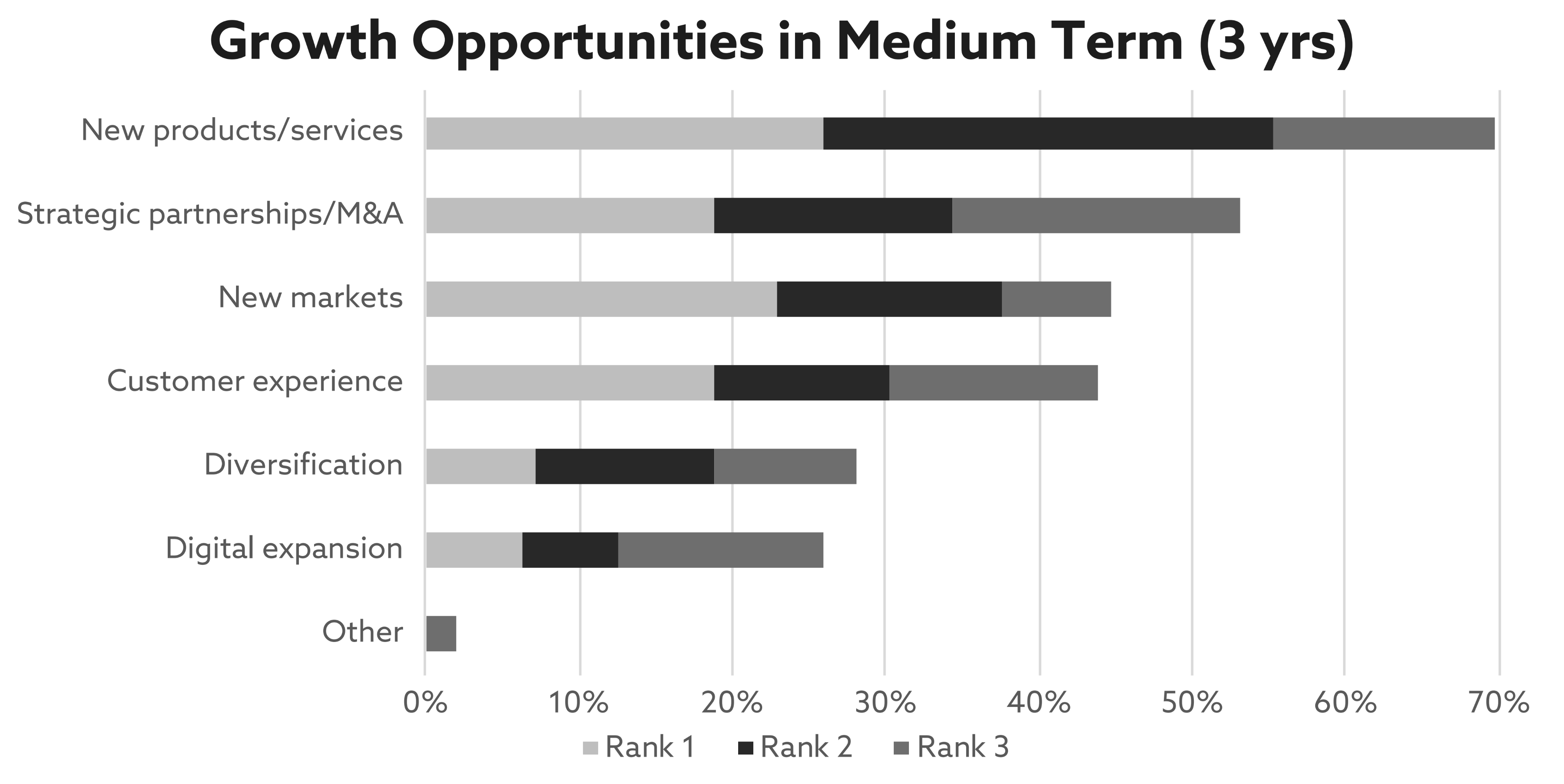
That changes the nature of the growth challenge. The question is whether the organisation has the model, capability, and discipline to deliver growth in conditions that are more demanding and less forgiving than before.
Growth is increasingly being built
Many of the businesses represented in the discussions are still exploring expansion opportunities, but they are doing so more carefully than in previous periods. Some are entering adjacent markets. Others are targeting new customer groups or extending proven capabilities into related areas. In most cases, this is about using what already exists — brand, expertise, product strength, customer insight, and operational capability — in more inventive or commercially disciplined ways.
That is one reason market expansion remains significant even in a constrained environment. It is less about broad geographic optimism and more about finding realistic, evidence-based ways to access new demand. Strategic partnerships and M&A also feature strongly in the research, suggesting that many organisations are looking beyond organic growth alone and considering more collaborative or accelerated routes to scale.
These decisions, however, are being made with greater caution. Leaders described stronger emphasis on testing assumptions, understanding execution risk, and ensuring the business is financially, operationally, and legally ready before committing to expansion. Growth readiness, in that sense, is becoming as important as growth ambition.
Product and service innovation has become one of the clearest growth levers
If there is one theme that cuts through the research most strongly, it is the importance of innovation. New products and services stand out as the single most significant medium-term growth opportunity in the data. That matters because it shows how many organisations are now looking inward for growth as much as outward. Rather than depending on stronger market conditions to lift them, they are focusing on how to create more relevant, differentiated, or commercially valuable offers in markets where demand is harder to unlock.
For many leaders, this is about practical, targeted evolution: refining existing offers, adding complementary services, and responding more closely to changing customer needs. That approach allows organisations to pursue growth while managing risk, because it builds on established strengths rather than requiring entirely new infrastructure, capabilities, or market assumptions.
In a low-growth environment, that kind of disciplined innovation becomes especially valuable. It gives businesses a way to grow without overextending and a way to stay relevant without placing everything on a single strategic leap.
Customer experience is part of the growth model
Another major shift in the discussions was the role of customer experience in shaping commercial performance. In a low-growth market, organisations cannot assume that new customer acquisition will always be the easiest route to performance. Several leaders described a stronger focus on retention, relationship strength, lifetime value, and responsiveness to changing customer expectations. In those conditions, customer experience becomes more than a service issue. It becomes part of the growth model itself.
That point is reinforced by the research, where customer experience ranks alongside new markets as one of the most important medium-term growth opportunities. This is a telling result. It shows that leaders are are also asking how to increase value inside the customer base they already have.
That is an important distinction. In constrained markets, growth often depends less on scale and more on quality — better customer understanding, stronger relevance, more responsive delivery, and a clearer reason for customers to stay, spend, and recommend. Several contributors highlighted the growing importance of real-time customer feedback and insight in helping businesses adapt more quickly and sharpen their offer over time.
The real challenge is making the trade-offs that allow growth to happen.
Growth strategy in the current environment is defined as much by constraint as by opportunity. Leaders described the need to balance short-term financial performance with long-term investment, risk management with opportunity capture, and tighter cost control with continued capability development. These are not easy trade-offs. In many cases, organisations are delaying or scaling back growth initiatives because the wider environment makes timing, funding, or execution more difficult.
This is where the strategic posture data becomes especially useful. Most organisations describe their stance as balanced: managing risk while still pursuing growth. Smaller groups are being more selective through cautious investment, while relatively few are taking explicitly aggressive, defensive, or transformational positions. That distribution suggests that leaders are trying to pursue growth without overcommitting.
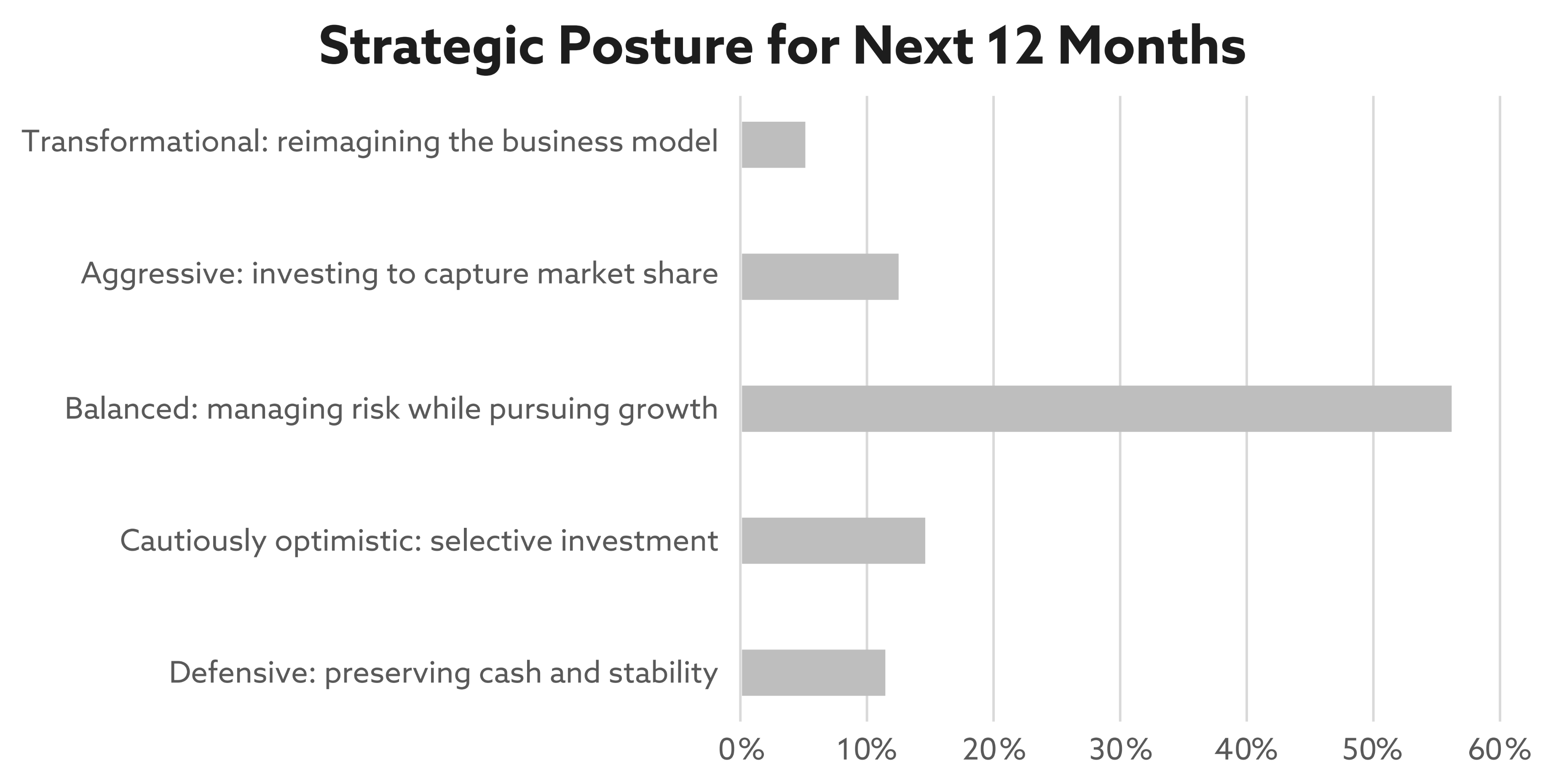
That posture is understandable. It also introduces a risk of strategic drift. If caution becomes too dominant, investment is delayed repeatedly and strategic options narrow over time. Several contributors made the point directly: not investing also carries risk. Delayed product development, postponed customer improvements, or hesitation around new markets can leave organisations weaker later, even if financial discipline looks sensible in the short term.
This is why growth strategy now depends less on bold rhetoric and more on disciplined judgement. The issue is not simply whether to invest, but where, when, and with what level of conviction.
Execution is becoming the real differentiator
One of the most important themes in the discussions was that many organisations now have broadly similar growth ambitions. What separates them is execution. In more favourable markets, strategic weakness can sometimes be masked by momentum. In low-growth conditions, that becomes much harder. Growth has to be earned, and that places greater weight on the ability to implement well. Leaders pointed to the importance of aligning teams around clear priorities, allocating resources with discipline, and maintaining focus long enough for strategy to translate into outcomes.
This matters even more because growth strategies are becoming broader and more layered. Product innovation, customer experience, partnerships, expansion, diversification, and digital channels can all be part of the same agenda. That may be strategically coherent, but it also increases execution complexity. The more levers an organisation tries to pull at once, the greater the need for strong leadership coordination, clear sequencing, and consistent delivery discipline.
As one participant put it, the challenge is often executing right strategy consistently.
Better growth decisions are increasingly being built on better information
Another clear theme running through the discussions was the growing role of data and insight in shaping growth strategy. Leaders described using better information to identify opportunities, understand customer behaviour, monitor performance, and refine decision-making over time. That marks a broader move away from instinct-led growth planning towards more analytical and evidence-based models.
In some cases, organisations are bringing together customer insight, commercial data, and operational metrics to build a fuller picture of performance and demand. That allows leadership teams to test assumptions more rigorously and adjust direction earlier when results or market signals begin to shift.
Dan Appleby, Managing Director of Drummond Central, illustrated what this looks like in practice. By strengthening the planning capability within the business, the agency moved towards ideas and decisions shaped more by customer insight and strategic evidence, rather than relying solely on instinct or creative judgement. That is a useful example because it shows how better decision-making can itself become part of the growth model.
What business leaders should take from this
The broader lesson from the research is that growth strategy is being reshaped by it. In a low-growth environment, success depends less on scale alone and more on precision — better choices, sharper positioning, more selective investment, and stronger execution. The businesses most likely to grow are the ones making the clearest decisions and following through with the greatest discipline.
For leadership teams, that creates three practical priorities. First, growth needs to be driven through several levers rather than a single route. Product and service innovation, customer experience, partnerships, and market expansion all have a role to play, but they need to be pursued in combination and with clear logic. Second, financial discipline and growth ambition must be managed together. Underinvestment and overextension both create risk. Leadership strength now lies in judging where commitment is essential and where caution is warranted. Third, execution capability needs to be treated as central to growth strategy rather than secondary to it. In constrained conditions, the ability to translate intent into action becomes one of the clearest sources of competitive advantage.
Strategic growth, therefore, is about choosing more carefully, investing more precisely, and executing more effectively when every decision carries greater weight. In a lower-growth market, the organisations that win are less likely to be the ones with the boldest ambitions than the ones with the strongest follow-through.
Download the full report
This article draws on Nigel Wright Group’s wider research into business resilience and growth, alongside executive roundtable discussions with senior business leaders. To explore the full findings, broader market themes, and strategic implications in more detail, download the full report.
Building Resilient Growth Report
This report is based on Nigel Wright Group’s market research across the North of England, examining attitudes to business resilience and growth strategies at the start of 2026.

By submitting your details, you have read and understood our Privacy Notice