Resilience has become one of the most widely used concepts in business. Boards talk about it, leadership teams plan around it, and many organisations take continued performance as evidence that they can withstand disruption. In practice, the picture is often more complicated. A business can look resilient from the outside while relying internally on stretched teams, delayed investment, and a narrowing margin for error.
This article draws on Nigel Wright Group’s research into business resilience and growth across the North of England, combined with executive roundtable discussions with senior business leaders. Together, those insights suggest that resilience is increasingly defined by whether it can continue to adapt and perform while financial pressure, workforce strain, and operational complexity all intensify at the same time.
That distinction matters. Many organisations still assess resilience by outcomes alone: if performance holds, the business is assumed to be resilient. The stronger test is whether that performance is being sustained by a robust operating model, or by short-term adjustments that may become harder to maintain over time. In other words, the real question is whether the business is genuinely prepared for what comes next.
Key Questions Answered
What does organisational resilience mean in today’s environment?
It means maintaining performance while adapting to sustained financial, workforce, market, and operational pressure.
Why is there often a gap between perceived and actual resilience?
Because many organisations preserve results by delaying hiring, reducing investment, restructuring operations, or stretching teams, which can conceal deeper vulnerability.
What factors strengthen or weaken resilience in practice?
Financial headroom, workforce capacity, operational flexibility, leadership effectiveness, and the ability to respond quickly to change all shape resilience in practice.
How are organisations adapting their approach to resilience?
The strongest organisations are moving away from static definitions of resilience and toward more adaptive models built around flexibility, insight, capability, and better decision-making.
What does organisational resilience actually mean now?
Organisational resilience has become a broader and more demanding concept than many businesses still assume. It is about responding, adjusting, and continuing to perform when pressure becomes prolonged, repeated, or multi-dimensional. That makes resilience a function of financial stability, market visibility, workforce capability, operational flexibility, and leadership effectiveness rather than a single measure of continuity.
The research underlines why that broader definition is necessary. Market unpredictability was the most commonly reported source of disruption over the previous 12 months, affecting almost half of respondents. Talent and skills shortages followed at around two in five, while supply chain disruption and regulatory or compliance change were also significant pressures. Fewer than one in five respondents reported no disruption at all.
That matters because resilience is no longer a static attribute. A business can appear stable externally while operating very close to capacity internally. Strong performance may still be real, but it does not automatically mean the organisation is well insulated or well prepared for further pressure. Increasingly, resilience has to be understood as an adaptive capability that needs to be tested, renewed, and strengthened over time.
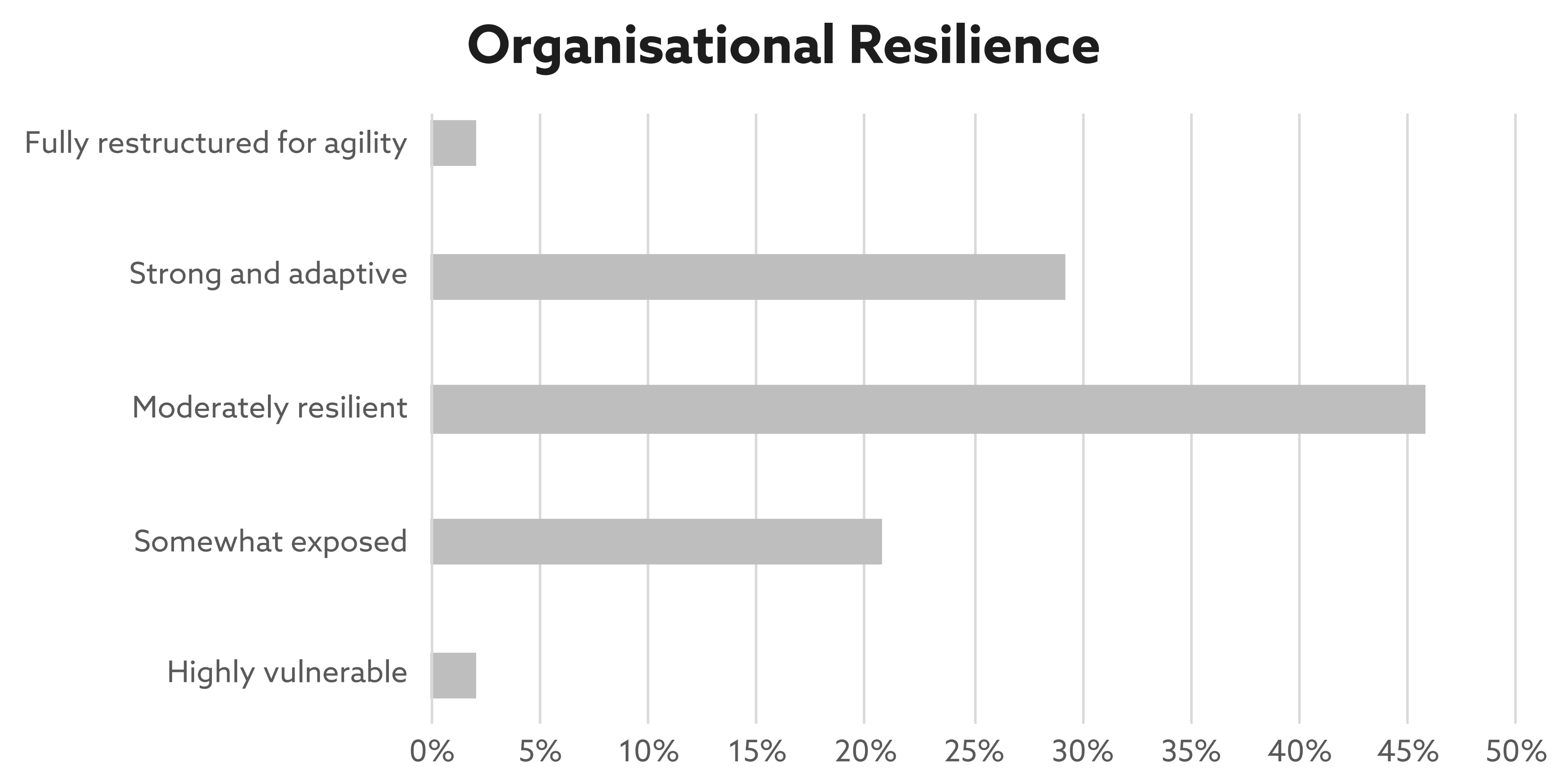
Best placed here because it visualises the article’s core distinction between moderate resilience and truly strong, adaptive resilience, immediately after the section that redefines what resilience now means in practice.
Why can resilient-looking organisations still be vulnerable?
One of the clearest insights from the research is the gap between perceived resilience and operating reality. Many organisations are maintaining performance, but often by making choices that create hidden strain elsewhere in the business. That can include holding back on recruitment, slowing investment, compressing teams, or postponing capability-building work that would matter over the longer term.
The pattern is visible in the actions organisations have already taken. More than 40% had delayed hiring, more than a third had reduced investment, around a third had increased pricing, and just over half had restructured operations. Around a quarter had made redundancies, while only a small minority reported making no strategic changes at all. Those actions may be commercially necessary, but they also show how often resilience is being maintained through trade-offs rather than through deep structural strength.
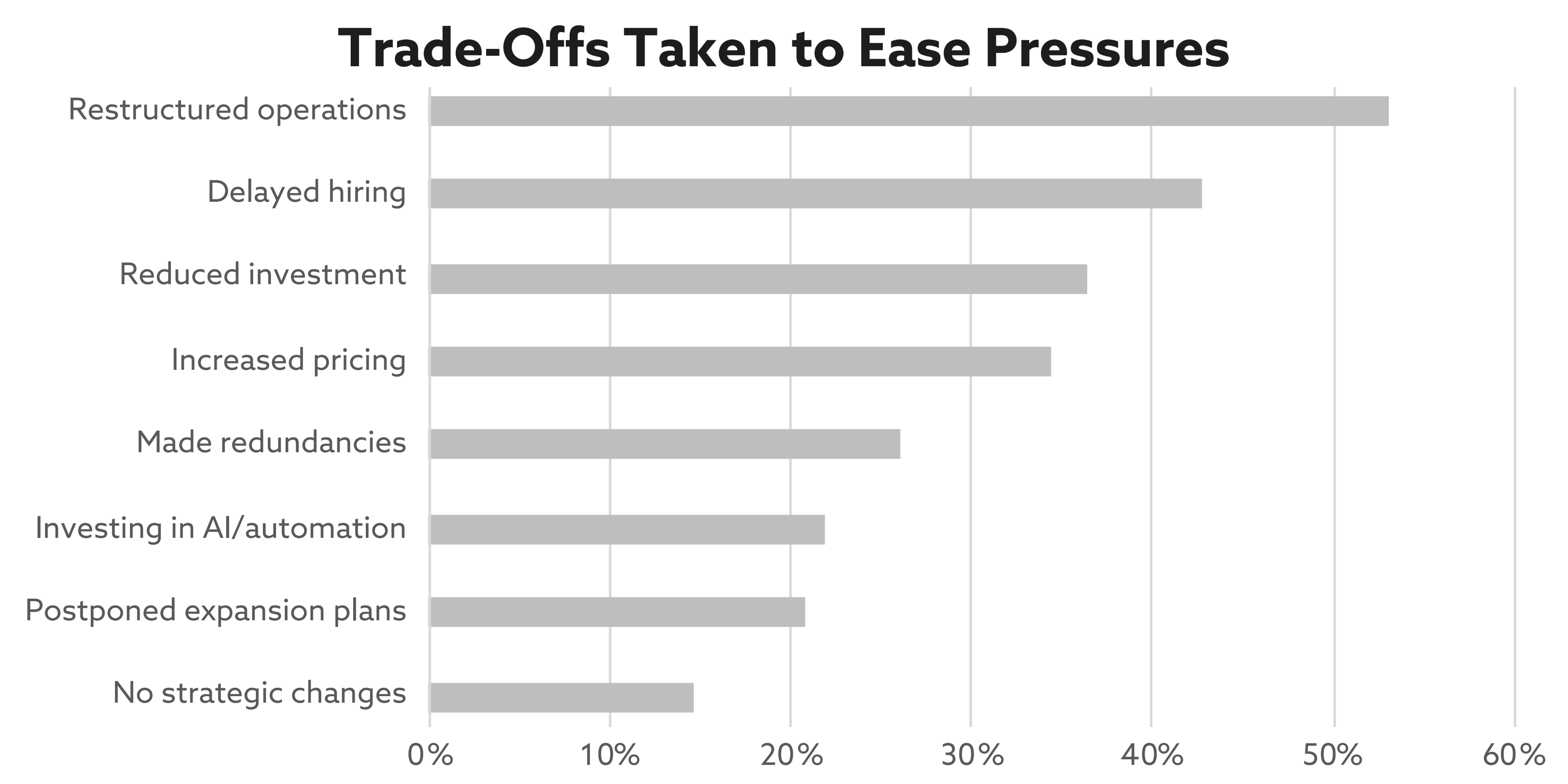
Best placed here because it gives direct evidence for the argument that many businesses are preserving performance through delay, compression, and operational trade-offs rather than through deep underlying resilience.
This is the crucial distinction. A business can continue to deliver while storing up future vulnerability. Teams may be overstretched, transformation may slow, and investment may be deferred even as headline performance appears steady. Once that happens, resilience starts to depend less on structural preparedness and more on how long people and systems can continue absorbing pressure.
For leadership teams, that means looking beneath the surface. The practical test is whether the business is genuinely structured to remain effective under pressure, or whether it is holding together through extra effort, deferred decisions, and dependence on a limited number of critical people.
Why does financial pressure now sit at the centre of resilience?
Financial resilience has moved from being one part of the discussion to becoming central to it. Wage inflation emerged as the most significant operational pressure in the research, with changing customer demand, recruitment and retention challenges, debt and cashflow concerns, technology investment pressure, and wider cost increases also affecting organisations’ room to manoeuvre.
This reshapes resilience in three ways. First, it reduces the ability to absorb further shocks. Second, it limits the capacity to invest in future capability. Third, it increases reliance on efficiency measures and cost control simply to maintain current performance. Financial discipline remains essential, but the tension is clear: the actions taken to preserve short-term stability can reduce investment in the very capabilities that would strengthen long-term resilience.
That is one of the most important shifts in how resilience should now be understood. Financial resilience is a core part of organisational resilience because it determines how much room leaders have to respond, invest, and adapt when conditions move against them.
How much of today’s resilience is being carried by the workforce?
In many organisations, workforce resilience is carrying more of the load than leadership teams fully recognise. Employees are being asked to absorb pressure, manage change, and sustain performance while operating within tighter cost constraints and more demanding trading conditions. In the short term, that can create the impression that the organisation is coping well. Over time, it can expose how much resilience depends on individual effort rather than organisational design.
The risks are clear. Teams may already be working at high utilisation. Critical roles may be hard to replace. Skills gaps may reduce the organisation’s ability to respond flexibly when priorities shift. Under sustained pressure, those conditions can eventually affect engagement, retention, and future capability even if current performance still looks stable.
One participant in the executive discussions captured the issue directly: organisational resilience is often being underpinned by individual resilience, and that becomes difficult to sustain over time. That observation should give leadership teams pause. If resilience is being borrowed from people rather than built into the operating model, the business may be more exposed than headline performance suggests.
What are stronger organisations doing differently?
The most encouraging theme in the research is that some organisations are starting to move from static resilience to adaptive resilience. Instead of relying on structures designed to withstand one type of disruption, they are building greater capacity to respond to a wider range of changing pressures over time.
That shift is reflected in strategic priorities. Operational efficiency emerged as the clearest priority over the next three years, but market expansion, talent and leadership development, AI and automation, and digital transformation also featured strongly. That combination matters. It suggests resilience is no longer being treated purely as a defensive agenda. More organisations are trying to build operating models that support control and growth at the same time.
In practice, that means greater emphasis on flexible operating models, stronger access to data and insight, better cross-functional alignment, and leadership capability that supports faster, more informed decisions. In an environment where uncertainty is ongoing rather than exceptional, adaptability is becoming more valuable than static stability.
What is the real strategic risk for leadership teams?
The biggest risk may be overestimating resilience. Organisations that assume they are resilient can become slower to confront underlying weaknesses, less willing to invest in capability, and less responsive to emerging pressure. A business that appears stable can gradually start to treat its current model as sufficient even while the foundations beneath it become more fragile.
The research suggests that most organisations are taking a balanced posture, managing risk while still pursuing growth. A smaller group is maintaining cautious optimism through selective investment, while only a relatively limited share is taking a more aggressive or transformational stance. That may be sensible in the short term. It also raises a harder question: how many organisations are protecting today’s performance while quietly delaying the deeper changes future resilience will require?
This is why resilience needs to be assessed more honestly. Outcomes matter, but so do the underlying conditions that make those outcomes possible: workforce capacity, cash visibility, governance, operational dependencies, process strength, and the level of strain required to keep the organisation on track.
What should business leaders do now?
The central lesson is that resilience is an adaptive capability that requires active attention.
For leadership teams, that means three practical shifts. First, resilience needs to be judged more rigorously. Headline stability is not enough if investment is being deferred, teams are overstretched, and capability is narrowing beneath the surface. Second, resilience and financial strategy need to be considered together, because the ability to preserve cash, absorb cost pressure, and maintain investment capacity now sits at the heart of organisational adaptability. Third, resilience should be built deliberately through operating model design, better insight, leadership capability, and stronger organisational alignment rather than being left to short-term control measures alone.
Most importantly, leaders should avoid confusing continuity with preparedness. The organisations most likely to perform well over the coming years will be the ones building the capacity to perform, adapt, and grow while uncertainty remains part of the operating environment.
Resilience, therefore, is about sustaining capability in conditions where uncertainty has become part of the job.
Download the full report
This article is based on Nigel Wright Group’s wider research into business resilience and growth across the North of England, alongside executive roundtable discussions with senior business leaders. To explore the full findings, strategic implications, and broader leadership considerations in more depth, download the full report.
Building Resilient Growth Report
This report is based on Nigel Wright Group’s market research across the North of England, examining attitudes to business resilience and growth strategies at the start of 2026.
By submitting your details, you have read and understood our Privacy Notice