
For many organisations, the critical question is whether the current model still matches the demands being placed on it. Pressure on talent, productivity, technology, and customer delivery is forcing leadership teams to look beyond incremental efficiency gains and ask harder questions about how work is structured, coordinated, and scaled. In more demanding conditions, operating model strength is moving much closer to the centre of competitive performance.
This article draws on Nigel Wright Group’s wider research into business resilience and growth, alongside executive roundtable discussions with senior business leaders. Together, those discussions point to a broader shift beyond workforce redesign alone. Organisations are rethinking how work is organised, delivered, and governed in response to uncertainty, fast-moving technology, and changing customer expectations. Traditional models built for stability and scale are increasingly being tested by environments that reward flexibility, responsiveness, and faster decision-making.
That shift matters because the operating model increasingly shapes whether a business can respond quickly enough, coordinate effectively enough, and adapt confidently enough to deliver its strategy. Where legacy structures make that harder, operating model innovation stops being optional and starts becoming a strategic necessity.
Key Questions Answered
How are organisations evolving their operating models?
They are moving towards flatter structures, wider cross-functional collaboration, more distributed ways of working, and models that give teams greater speed and flexibility.
What role does technology play in operating model innovation?
Technology expands what organisations can do, but only creates value when leadership, process, and organisational design evolve alongside it.
How is the future of work influencing organisational design?
Work is becoming more automated, more knowledge-led, and more fluid, which means operating models need to adapt continuously rather than being optimised only for current conditions.
What capabilities are required to build more flexible operating models?
Leadership teams need the ability to integrate people, process, and technology, while balancing adaptability with control and maintaining clarity in more distributed environments.
Traditional structures are becoming harder to defend
One of the clearest themes in the discussions was the limitation of traditional organisational structures. Leaders described models built around functional silos, hierarchical decision-making, and fixed roles and responsibilities. Those arrangements can still provide clarity and control, but they can also slow response, reduce agility, and make collaboration harder at exactly the point where the market is demanding more speed and adaptability.
That is why more organisations are exploring models that allow faster decisions and wider collaboration across teams. Flatter structures, cross-functional working, and greater decentralisation are becoming more attractive because they align more closely with the pace of current market conditions. The operating model, in that sense, is becoming a strategic lever rather than an organisational backdrop. It shapes how quickly the business can respond to opportunity, deal with risk, and coordinate change across multiple moving parts.
The wider implication is important. In more volatile environments, the question is whether the model itself still supports the level of responsiveness and coordination the business now needs.
Technology is changing the model
Technology emerged as one of the main drivers of operating model change. Participants highlighted a growing shift towards platform-based and service-orientated models, particularly in sectors moving through digital transformation. Software-as-a-Service models were one example discussed, illustrating how organisations are moving from one-off products towards continuous, scalable service relationships.
That shift alters more than the technology stack. It changes how value is created and delivered. Organisations moving in this direction are focusing more heavily on ongoing customer relationships, recurring revenue models, and continuous service improvement. That requires a rethink not only of technology infrastructure, but of commercial models, customer engagement, and internal process design. In those cases, the operating model becomes inseparable from the commercial model. The way the organisation sells, supports, licences, and protects its offering directly affects revenue quality, scalability, and risk.
This is one reason operating model innovation is becoming more pressing. Once the organisation shifts towards more dynamic service, subscription, or platform-based delivery, legacy operating assumptions often stop being sufficient.
Technology enables flexibility
One of the sharpest points to come through in the discussions was that technology is central to creating more flexible operating models, but it does not create flexibility by itself. Digital tools that support remote and hybrid working, systems that improve visibility across operations, and AI or automation that strengthen efficiency and decision-making all expand what organisations can do. They reduce some of the constraints that once shaped location, time, and resource deployment, and they open up new possibilities for structuring work differently.
The second half of the point is just as important. Organisations only realise that benefit when technology is matched by aligned processes, leadership, and culture. Installing new systems without changing how decisions are made, how teams operate, or how work flows through the business often leaves old inefficiencies intact.
That distinction helps explain why some transformation programmes create visible technology change without creating equivalent performance improvement. Substantive operating model innovation happens when systems, workflows, and decision-making evolve together rather than in isolation.
Location flexibility is expanding what organisations can do — and what they have to manage
Another major theme was the growing flexibility of workforce location. Leaders described continued movement towards remote and hybrid working, distributed teams, and greater access to talent beyond traditional geographic boundaries. These shifts help organisations address talent shortages, reach specialist capability, and optimise cost more effectively across the workforce footprint.
That kind of flexibility also creates new operating demands. Communication becomes harder to manage across locations. Organisational culture is more difficult to sustain. Consistency of delivery can weaken if coordination is poor. As a result, leadership teams need stronger approaches to collaboration, performance management, and decision-making in more distributed environments.
There are also practical considerations beneath the model. Tax, employment, and corporate structures can become more complex as workforce flexibility expands across jurisdictions or working arrangements. A more flexible model still depends on clear rules, defined accountabilities, and enough control underneath it to remain workable at scale.
The strongest operating model changes integrate people, process, and technology
A key insight running through the discussions was that successful operating model innovation depends on the integration of three core elements: people, process, and technology. Focusing on one in isolation rarely produces meaningful change. New systems introduced without process redesign often reproduce inefficiencies in a different form. Team restructuring without changes to workflows or decision rights can leave exactly the same bottlenecks in place.
The organisations seen as making the strongest progress were those taking a more joined-up view. They were aligning technology, people, and process directly against strategic objectives and redesigning them in combination. That is what allows operating model change to become substantive rather than cosmetic. Cosmetic change adjusts the surface. Substantive change alters how work actually moves through the organisation.
That is one of the most important practical lessons in the article. Operating model innovation becomes real only when the business is redesigned as a whole rather than through isolated changes to systems, teams, or reporting lines.
The future of work requires models that can keep evolving
The future of work was another recurring theme across the discussions. Participants described a labour and technology environment in which routine activity is increasingly automated, higher-value roles depend more on knowledge and judgement, and career paths are becoming more fluid. These pressures are changing both the shape of work and the way organisations need to structure around it.
Several contributors stressed that operating model change can no longer be treated as a one-off redesign exercise. Organisations need models that can evolve over time rather than simply being optimised for current conditions. That requires more adaptive thinking from leadership teams and stronger internal capability to keep redesigning the business as technology, workforce expectations, and market conditions continue to shift.
The practical implication is clear: if work is becoming more automated, more knowledge-led, and more fluid, then leadership teams need operating models capable of absorbing ongoing redesign rather than periodic restructuring alone.
Flexibility only works when it is balanced with control
Flexibility was a clear objective in many of the examples discussed, but leaders were equally clear that flexibility without control can create fresh problems. More adaptive models can weaken governance, blur accountability, reduce process consistency, and increase risk if the underlying framework is not clear enough.
This creates a familiar leadership challenge. Teams need enough freedom to respond quickly and work across boundaries. The organisation still needs enough structure to protect service quality, accountability, and standards. The same logic applies to outsourcing, franchising, and partnership-based models. These arrangements can increase flexibility, but only when contracts, governance, and performance management are well defined. In each case, operating model innovation depends on finding the right balance between adaptation and control.
This matters because some of the greatest operating model risks come from redesigning the model in ways that weaken clarity faster than they improve responsiveness.
What business leaders should take from this
The broader lesson from the roundtables is that operating model innovation is becoming a core part of organisational strategy. It reflects a wider recognition that how a business works is becoming as important as what it is trying to achieve. In more demanding conditions, the organisations most likely to perform strongly will be the ones with operating models capable of delivering that ambition with enough speed, clarity, and resilience.
For leadership teams, several implications follow. They need to look beyond incremental efficiency improvement and ask whether the current operating model is genuinely fit for purpose in a changing environment. They need to treat technology as an enabler of flexibility and productivity while ensuring it is integrated with wider organisational change. They need to build the capability required to lead more adaptive, more distributed, and more complex models. And they need to accept that operating model innovation is not a one-off programme. External conditions will keep changing, which means structures, processes, and capabilities will have to keep changing with them.
Operating model strength, therefore, is becoming part of competitive advantage itself.
Download the Full Report
This article draws on Nigel Wright Group’s wider research into business resilience and growth, alongside executive roundtable discussions with senior business leaders. To explore the full findings, broader market themes, and strategic implications in more detail, download the full report.
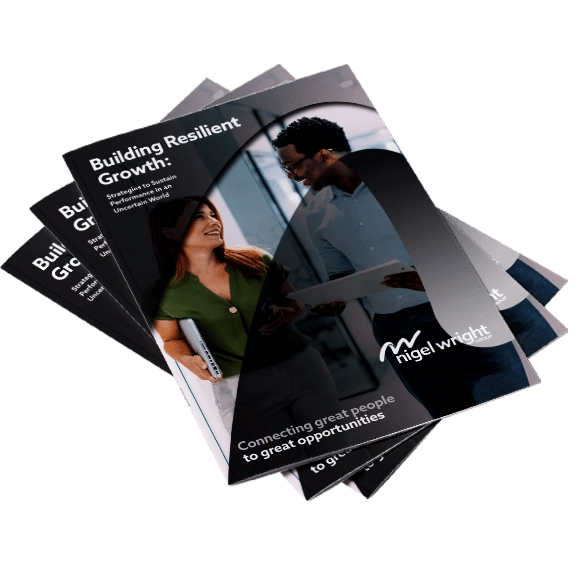
Building Resilient Growth Report
This report is based on Nigel Wright Group’s market research across the North of England, examining attitudes to business resilience and growth strategies at the start of 2026.
By submitting your details, you have read and understood our Privacy Notice