
For many organisations, disruption has become part of the baseline operating environment. Investment decisions, growth plans, workforce strategy, operating model design, and leadership choices are now all being made in conditions where volatility, uncertainty, and rapid change can no longer be treated as exceptional.
This article draws on Nigel Wright Group’s wider research into business resilience and growth, alongside executive roundtable discussions with senior business leaders. What emerges is a clear shift in how risk is understood. Economic volatility, geopolitical disruption, technological change, and changing market conditions are shaping strategy itself. In that context, risk moves from being a specialist topic into a central part of decision-making.
That shift matters because effective risk management now depends less on trying to separate risk from strategy and more on recognising that the two are increasingly intertwined. The question is whether the organisation can keep making sound decisions while uncertainty remains part of the environment in which it operates.
Key Questions Answered
How are organisations managing risk in uncertain conditions?
By embedding risk more directly into leadership decision-making, financial planning, operating model design, and growth strategy rather than treating it as a separate control process.
What types of risk are most relevant to business leaders today?
Financial, operational, technological, and talent-related risks all remain significant, but they are becoming more interconnected and harder to manage in isolation.
How do leaders balance risk with growth and investment?
By treating caution and action as competing risks and making more deliberate judgements about where restraint protects value and where it quietly erodes future competitiveness.
What strategies are effective in managing ongoing uncertainty?
Greater flexibility, stronger profitability, clearer leadership judgement, and tighter integration between risk and strategy are becoming some of the most effective responses.
Uncertainty is no longer a phase
One of the clearest messages from the discussions was that leaders now have to manage risk without assuming stable conditions will return in the near term. Geopolitical instability, economic fluctuation, regulatory change, and rapid technological advancement are widening the range of risks organisations face and increasing the speed at which conditions evolve.
That changes the practical challenge. The issue now is how well organisations can operate within an environment of uncertainty. Businesses no longer have the luxury of postponing major decisions until disruption passes. They need structures, processes, and leadership capability that allow them to keep moving while the environment remains unsettled.
This is what makes risk management more central to strategy than before. In a permanently uncertain environment, resilience depends less on isolating risk events and more on building decision-making models that can absorb change without losing direction.
Risk now cuts across every major business decision
The discussions highlighted several categories of risk shaping business decisions more directly than before. Financial risk remains prominent, especially in the context of cost pressure, wage inflation, and constrained access to capital. Operational risk is becoming more complex as workforce changes, supply chain dependencies, and evolving operating models introduce new points of failure. Technology-related risk is rising too, as AI and digital tools bring both opportunity and exposure around adoption, governance, and misuse. Talent-related risk continues to influence organisational capacity, particularly where shortages of skilled individuals increase dependence on key roles.
The most important point is that these risks are no longer easy to separate. Financial pressure can shape workforce decisions. Technology choices can create operational exposure. Talent shortages can affect execution and strategic timing. Risk is becoming more interconnected, more fluid, and more difficult to manage through narrow specialist lenses.
The discussions also pointed to vulnerabilities that often remain hidden until pressure intensifies — outdated contracts, unclear ownership structures, or over-reliance on key customers, suppliers, or individuals. These weaknesses may remain manageable in normal trading conditions, but can become much more serious during transactions, disputes, restructuring, cyber incidents, or leadership change.
Growth still requires risk, even in more cautious conditions
One of the most important tensions running through the roundtables was the relationship between risk and growth. Organisations need to protect financial performance, preserve stability, and manage downside exposure. At the same time, they still need to invest in future capability and pursue growth. That balancing act is now shaping leadership behaviour more directly than before. In some cases, it is producing more cautious decision-making. In others, it is forcing sharper judgements about which risks are worth taking and where restraint becomes self-defeating.
Participants described cases where continued uncertainty led organisations to delay investment or scale back plans. Yet the discussions were equally clear that caution carries its own risk. Failing to invest in innovation, capability, or growth can weaken competitiveness over time. Excessive restraint may protect short-term stability while quietly eroding longer-term resilience. That is why managing risk now requires a more balanced approach — one that allows organisations to take calculated risks while maintaining control.
The implication is important. Growth and risk ncreasingly need to be considered together, because avoiding risk entirely can become a strategic risk in its own right.
Profitability is increasingly being treated as a risk strategy
Executives repeatedly described profitability as a form of protection. Strong financial performance gives organisations greater resilience to external shocks, more flexibility to invest when opportunities arise, and less dependence on external funding. That perspective matters because it moves profit beyond being a simple measure of past performance. It becomes part of how organisations preserve strategic room to manoeuvre.
This shift influences a broad range of decisions, from cost management to investment planning. It affects how leaders think about the trade-off between resilience and opportunity and reinforces a pattern seen elsewhere in the research: many organisations are prioritising profitability alongside, and in some cases ahead of, revenue growth.
That is one of the article’s most useful practical insights. In uncertain conditions, profitability is part of the organisation’s risk response because it determines how much pressure the business can absorb without losing strategic freedom.
Flexibility is becoming one of the most important risk responses
Another major theme in the discussions was the need to build greater flexibility into organisational structures and operating models. Leaders were clear that rigid models are less effective when conditions change quickly. More flexible structures allow organisations to adjust cost bases faster, reallocate resources as priorities shift, and respond to new risks and opportunities without becoming trapped inside legacy processes.
That often means streamlining processes, reducing fixed costs, and increasing the use of more variable resources. Technology can support that shift, but only when it is matched by the right processes, governance, and leadership capability. Flexibility on paper is not enough. The business has to be able to act on it under pressure.
This is why flexibility matters strategically, because it gives organisations more room to absorb shocks, redirect effort, and respond without triggering wider disruption across the business.
Leadership now sits at the centre of risk management
Risk management is now embedded in leadership decision-making rather than confined to specialist functions. That was one of the strongest themes in the discussions. Leaders are expected to make decisions with incomplete information, evaluate trade-offs between risk and opportunity, and maintain clarity and direction while conditions remain uncertain.
The leadership data supports that view. Over the next five years, respondents place greatest weight on strategic vision, empathy and people leadership, adaptability, and commercial acumen, ahead of more narrowly technical capabilities. That combination is revealing because managing uncertainty now depends on leaders who can set direction, bring people with them, adapt quickly, and apply sound judgement under pressure.
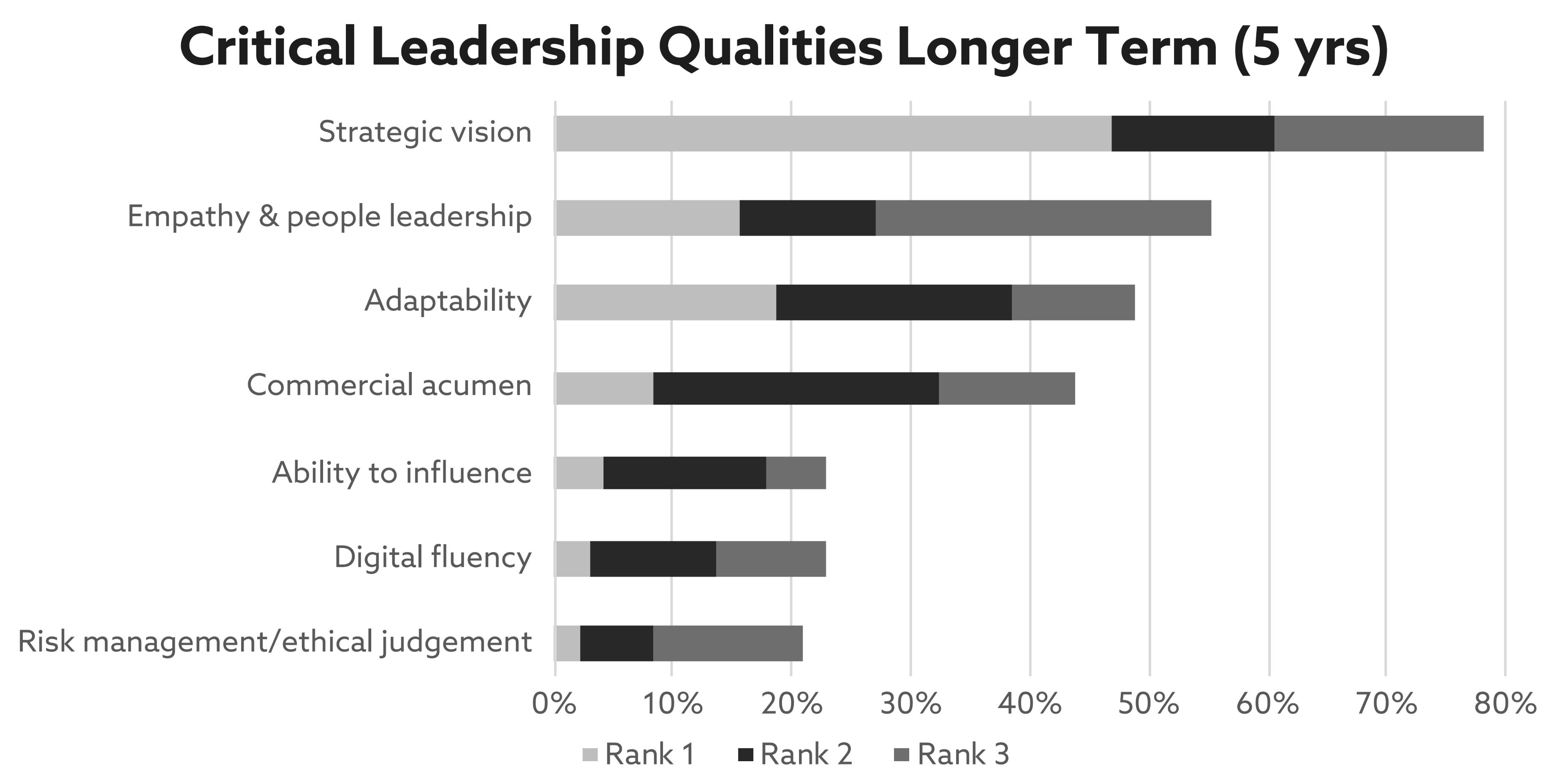
Strategic vision carries particular weight because risk is increasingly tied to choices about where the organisation should go next, not simply how it should avoid downside. Empathy and people leadership matter more because uncertainty now has to be led through organisations as much as around them. Several contributors also noted that decision-making has become more cautious, with greater scrutiny applied to investment and strategic initiatives. Others stressed the need to maintain momentum and avoid paralysis. That distinction matters. Leaders now have to navigate uncertainty rather than wait for it to pass.
Inaction creates its own risk
One of the most useful points raised in the discussions was the risk attached to inaction. Uncertainty often encourages caution, but delaying decisions or avoiding investment can create consequences of its own. In competitive markets, organisations that fail to act may lose ground to businesses that continue investing, evolving, and adapting. This is especially relevant in areas such as technology adoption, customer experience, and talent development.
As one participant noted, standing still is a strategic choice with implications of its own. That is why decision-making frameworks now need to support action even when conditions remain uncertain. The objective is taking informed decisions with enough confidence and structure to keep moving.
This is one of the clearest signs of how risk management has changed. Effective leaders now need to weigh the risk of acting against the risk of delay, because both can shape future competitiveness.
Risk works best when it is integrated directly into strategy
A broader conclusion from the discussions is that risk management now needs to be fully integrated into strategy. Leaders are embedding it within growth planning, financial decisions, and workforce or operating model design rather than treating it as a separate process. That allows organisations to consider risk and opportunity together rather than holding them in opposition. It also supports more agile decision-making because the business can respond in real time as conditions change.
Used well, risk can become a source of competitive advantage. Businesses that understand their exposures clearly are often able to move with greater confidence while others hesitate. Risk mapping, therefore, should be treated as a decision-making tool rather than a defensive exercise. Better visibility helps leaders decide where to invest, which opportunities to pursue, and where mitigation is needed before growth accelerates.
That is ultimately the article’s central message. Risk is increasingly part of how strategy is formed, tested, and executed.
What business leaders should take from this
The wider lesson is that managing risk has become a core leadership capability. In an environment defined by continuous uncertainty, organisations need to move beyond traditional approaches to risk and build models that are more adaptive, more integrated, and more closely tied to decision-making.
For leadership teams, several implications follow. Risk needs to be treated as an inherent part of strategy rather than an external issue to control separately. Caution and action both carry consequences, so leaders need to balance them more deliberately. Operating models need enough flexibility to respond quickly without losing control. Leadership capability matters more because organisations need people who combine strategic vision, adaptability, commercial judgement, and the ability to lead through change.
Effective risk management is about navigating it with confidence, clarity, and discipline.
Download the Full Report
This article draws on Nigel Wright Group’s wider research into business resilience and growth, alongside executive roundtable discussions with senior business leaders. To explore the full findings, broader market themes, and strategic implications in more detail, download the full report.
Building Resilient Growth Report
This report is based on Nigel Wright Group’s market research across the North of England, examining attitudes to business resilience and growth strategies at the start of 2026.

By submitting your details, you have read and understood our Privacy Notice