Most manufacturing businesses have a strategy, a set of values and a team they have worked hard to recruit. Many still make decisions slowly, miss deadlines and watch familiar problems return. Vicky Brockley of VB Consulting believes accountability is the missing link, and that leaders build it through courage: tackling issues that everybody can see and nobody is addressing.
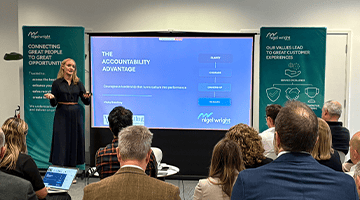
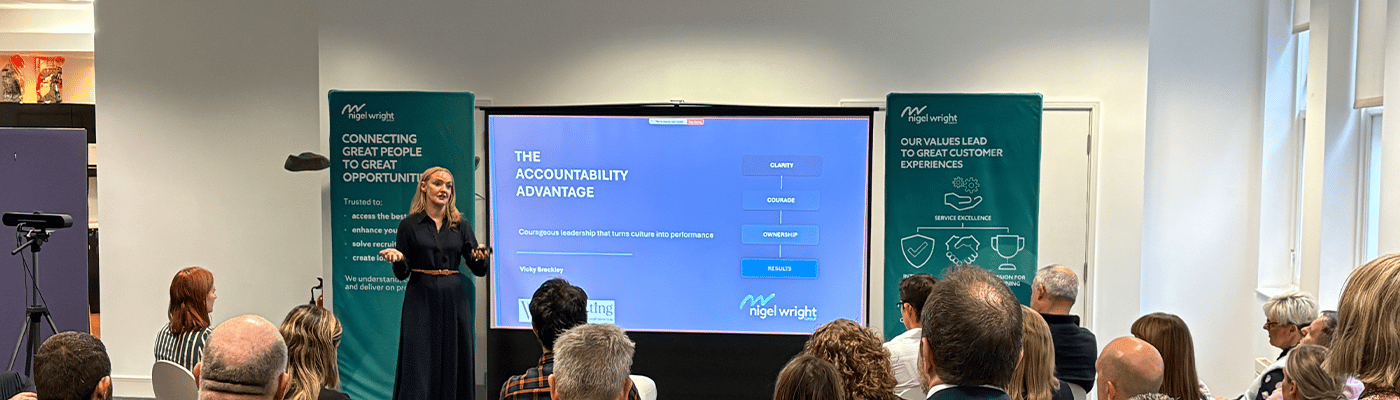
Vicky set out her case at The Accountability Advantage: Courageous leadership that turns culture into performance, the third session in Nigel Wright Group’s seminar series on people, culture and performance for manufacturing and industrial businesses. Senior leaders joined in person at our Newcastle headquarters and by video link.
Her view comes from experience. Vicky spent over 30 years running manufacturing sites and operations before becoming a leadership coach. “I’ve been sat in your seats,” she told the audience.
Why people decide performance as manufacturing becomes more data-driven
Operational data is easier for manufacturers to access, and people still decide whether it improves performance. Opening the seminar, Lisa Taylor, Associate Director at Nigel Wright Group noted that rising raw material and energy costs and global unpredictability have become close to business as usual for many of the clients we work with. Information on equipment downtime, productivity, supply chain and stock is now far more accessible. Very few manufacturers are fully automated, so results depend on helping people at every level, including long-serving operators on the shop floor, understand that information and the part they play.
Why accountability is the missing link between culture and results
Accountability is the bridge between having the right ingredients for success and actually succeeding. Vicky describes it as the difference between what a leader intended and the impact they had.
When results fall short, many leadership teams reach for a new initiative. Vicky argues the answer is usually already in the room: in meetings where people do not step up, actions arrive late and decisions keep returning to the leader until that leader becomes the bottleneck. Her advice is to stick with the strategy you have and get it executed.
Vicky asks every organisation she goes into what percentage of its people truly take accountability. Over the past year, she has not been in a single business where the figure was above 50 per cent.
Culture is the behaviour leaders tolerate
Culture is a repeated pattern of behaviours. In Vicky’s words, it is “what actually happens when nobody’s looking”: the conversation over coffee after everyone has been on their best behaviour in the meeting. She summarised the relationship simply: strategy is what matters; behaviours are what we do and accountability is what we confront.
“What we repeatedly tolerate does become the culture,” Vicky said, “and the culture does become your performance.” Each tolerated breach sets a new standard. A one-week deadline becomes two weeks, then three.
The shadow system behind the values on the wall
Every culture has a shadow system, according to Vicky. Values posters go up before a corporate visit, and the shadow is what happens on every other day. Its signs include:
- Passive agreement in the room, followed by different views outside it
- Deadlines missed without early warning
- Blame directed at other functions
- Decisions escalated upwards when people could own them
- Local KPIs winning over organisational goals
- Results rewarded while poor behaviour is ignored
The last point drew on a type of colleague Vicky has managed several times, whom she hypothetically refers to as Michael. He is the smartest person in the room and the first person you want when a problem needs solving, and his behaviour towards colleagues is appalling. Each time a leader thanks Michael for hitting the number, the organisation hears that his behaviour is acceptable.
“Where are you staying silent about something that actually you should be tackling?” Vicky asked. “In the silence,” she added, “is where the culture is actually happening.”
What a culture of accountability looks like in practice
Accountability means setting clear expectations about what a person needs to achieve, then helping them own the result. People who take accountability own outcomes, make explicit commitments, surface risk early, follow through on time and learn without becoming defensive. Follow-through is the area Vicky sees fail most often, and slow follow-through lets timelines slip.
Vicky acknowledged that accountability has gained a poor reputation, with many people assuming it means performance management. Formal performance management may become necessary after several conversations, and she places it at the end of the process, with clear expectations at the start. Micromanagement, public criticism and creating fear have no place in it.
“Trust without accountability becomes drift,” Vicky said. “Accountability without trust becomes fear.” She mapped the combinations like this:
- Low trust and low standards produce apathy
- Low trust and high standards produce fear
- High trust and low standards produce comfort, where nobody expects consequences
- High trust and high standards produce a performance culture
In a high-trust, high-standards culture, people can make mistakes and ask for support. The language is simple: “I believe we can do this and we need to address the gap.”
The multiplier effect of a more accountable workforce
Accountability is what Vicky calls “the multiplier effect”: raising the share of people who take it speeds up the whole organisation. When more people manage themselves, she described five changes:
- Fewer decisions bounce upwards, so execution speeds up
- Commitments survive outside the meeting
- Colleagues trust each other to do what they say
- Resistance surfaces early and in the room
- Top talent stops carrying the burden
The last point carries a hidden risk. Top performers attract extra work because they deliver, and the energy they first draw from that trust turns to frustration as they keep working after colleagues on the same salary have gone home. Left unaddressed, they leave, and the work escalates to the leader.
Why good leaders avoid accountability conversations, and what it costs
Good leaders sometimes avoid accountability conversations precisely because they are good people. Vicky listed the common reasons: kindness and wanting to be liked, long-standing relationships, standards that are implied and never stated, too many priorities to own, breaches that quietly become the norm, conversations held too late and a senior team that has not agreed what matters. One attendee recognised the priorities problem, describing multiple KPIs that left them triaging many priorities while driving few. Time is a barrier too, because starting these conversations adds to a full to-do list.
“What leaders tolerate, they endorse,” Vicky said. She compared avoidance to an overdraft: on day one little changes; by month two or three the interest has built up and the problem has grown. The debt lands in three places:
- The business suffers slower execution, duplication, politics and normalised underperformance
- Leaders fall into constant firefighting, which lowers their credibility and makes teams dependent on them
- Individuals lose the chance to develop, because they assume their current behaviour meets the standard, and their confidence suffers
“The conversations that you’re putting off today,” she said, “are the problems that you’ve got for tomorrow.”
How to hold accountability conversations that feel fair
Accountability conversations work best when they are respectful, direct and early. They often become difficult only when a behaviour has gone unchallenged for years. Vicky described a manager who felt it was too early to ask a new starter to switch to the business’s established framework. Her advice was that there is no better time: acknowledge the strengths, explain the framework and ask the person to work within it.
Every commitment needs five elements: the outcome, the owner, the deadline, what good looks like and a review date. Most leaders believe they already do this. Under pressure, the basics slip, and ten people leave a meeting with ten versions of what was agreed. “That basic is the rigour that holds people to account,” Vicky said.
A five-step conversation when a commitment slips
- Commitment: state what was agreed, for example that the proposal would be ready by Friday.
- Gap: name what happened. The proposal was not delivered, and nobody flagged the delay.
- Curiosity: ask “Help me understand what happened,” with no accusation or frustration.
- Ownership: agree what needs to happen now, and by when.
- Review: set a date, such as Tuesday, to close the loop.
Throughout, the task stays with the person. Managers who have this conversation with their own leader start to have it with their teams, and the expectation that people flag slippage early spreads through the organisation.
Stop rescuing and return ownership
Vicky believes most leaders, herself included, have fallen into the rescue trap under pressure: solving the problem for the person, taking the task back, accepting an explanation as a resolution or measuring effort over outcome. Each one stifles the person’s potential. Coaching questions hand ownership back:
- What outcome are you owning?
- What options have you considered?
- What decision do you recommend?
- What support do you need from me?
- What will you do next, and by when?
In a culture with trust, asking for support signals a wish to grow. If an agreed action has not happened, the curious question is simple: “We agreed this. What’s changed?”
Accountability starts with the executive team
A culture of accountability starts at the top. Vicky sometimes sits with senior teams who complain that their managers do not take accountability. Those managers work for them. Executive teams need to:
- Agree what matters most, such as keeping people safe and then fixing quality
- Demonstrate non-negotiable behaviours, such as never criticising fellow executives to the people who report to them
- Make clear which decisions belong to whom, so decisions stop escalating
- Agree how to handle conflict, through honest, curious and kind conversations in the moment
- Hold each other to account when board actions slip
“If the exec team avoids it with each other,” Vicky said, “the organisation learns what’s acceptable.” Her question for leadership teams: what do you tolerate as an executive team that you would hate to think was happening elsewhere in the organisation?
Three accountability actions to take tomorrow
Vicky closed with three actions:
- Clarify one thing. Choose a piece of work where expectations may be unclear and re-contract it by asking the other person for their understanding.
- Challenge one pattern. Have one conversation about a behaviour you have been tolerating, whether from a team member, a peer or someone more senior. It is never too early.
- Model accountability visibly. Find one way to show your own accountability, such as sharing more with your team about executive priorities and where projects are slipping.
She also invited leaders to measure their legacy in the conversations they had or avoided, as well as in growth, deals and the teams they built.
Accountability questions from the session
How can a leader raise accountability with senior peers?
Frame it as a collective issue for the leadership team. Vicky suggested opening with a simple observation, such as the seminar prompting you to ask how consistently the team holds its people to account, then sharing examples and inviting peers to comment on each other’s teams. Staying silent carries its own risk, because a strong performer surrounded by lower standards can grow frustrated enough to leave.
How do you talk about accountability without it feeling like blame?
Position it as an organisation-wide priority. Saying “as an organisation, we are maybe not as collectively accountable as we should be” removes the focus from any single person. In individual conversations, phrases such as “help me understand” and “what support do you need?” keep the discussion away from blame.
How can a project manager improve accountability without line management authority?
Make expectations and the escalation route clear from the start. Vicky’s advice is to speak to the individual first: explain that their actions keep slipping, that you need to report the slippage and that you want to understand the reasons before you do. Invite them to raise competing priorities with their own manager, since the project serves an organisational goal.
Strategy succeeds when people own delivery
“Strategy succeeds when people own delivery,” Vicky told the audience.
The same principle shapes how we approach technology at Nigel Wright Group. We are looking at ways to automate processes and standardise delivery across countries, with one aim: creating time for full conversations with more people, so we can share how different organisations approach similar problems. Closing the session, Lisa observed that the challenge Vicky described appears in engineering, chemical and recruitment businesses alike, and in any organisation with people at its heart.
To find out more about the seminar series, or to discuss a hiring requirement in your manufacturing or industrial business, contact Nigel Wright Group.