
Financial pressure is often discussed as though it were a temporary management problem: something to contain, navigate, and eventually move beyond. That is no longer how many leadership teams experience it. Across sectors, cost pressure, wage inflation, tighter capital conditions, and less predictable demand are combining to reshape what organisations can pursue, what they delay, and what becomes too risky to justify. In that environment, finance is increasingly defining its boundaries.
This article draws on Nigel Wright Group’s wider research into business resilience and growth, alongside executive roundtable discussions with senior business leaders. The picture that emerges is clear: organisations are still pursuing growth, but they are doing so under tighter constraints, sharper scrutiny, and a much stronger expectation of financial discipline.
That shift matters because it changes the role finance plays inside the business. Financial management is becoming a central influence on investment, hiring, risk appetite, and the practical shape of strategic decision-making.
Key Questions Answered
How are financial pressures affecting business strategy?
They are changing how organisations invest, hire, allocate resources, manage risk, and judge what growth is realistically achievable.
Why are cost pressures becoming structural rather than temporary?
Because wage inflation, operating costs, funding constraints, and demand uncertainty are now interacting continuously rather than appearing as one-off disruptions.
How are organisations adapting their financial approach?
They are tightening budgeting, increasing scenario planning, redesigning cost structures, and becoming more selective about where investment is protected.
What are the implications for growth and investment?
Growth remains on the agenda, but it is being pursued more cautiously, with delayed hiring, stricter investment tests, and closer attention to profitability and resilience.
Financial pressure is no longer being treated as temporary
One of the clearest messages from the discussions was that current financial pressures are increasingly seen by leaders as embedded within the operating environment itself. That view is being shaped by sustained wage inflation, rising input and operating costs, increased borrowing costs, and more cautious funding markets. These pressures overlap and reinforce one another, creating a context in which financial flexibility is harder to maintain and mistakes are more costly.
The wider research points in the same direction. Wage inflation stands out as the most significant pressure on operations by a clear margin, while changing customer demand and recruitment or retention challenges also rank highly. Debt and cashflow concerns, technology investment pressure, tax, compliance, and energy or raw material costs all add to the picture. What organisations are dealing with is multiple financial pressures affecting decision-making at once.
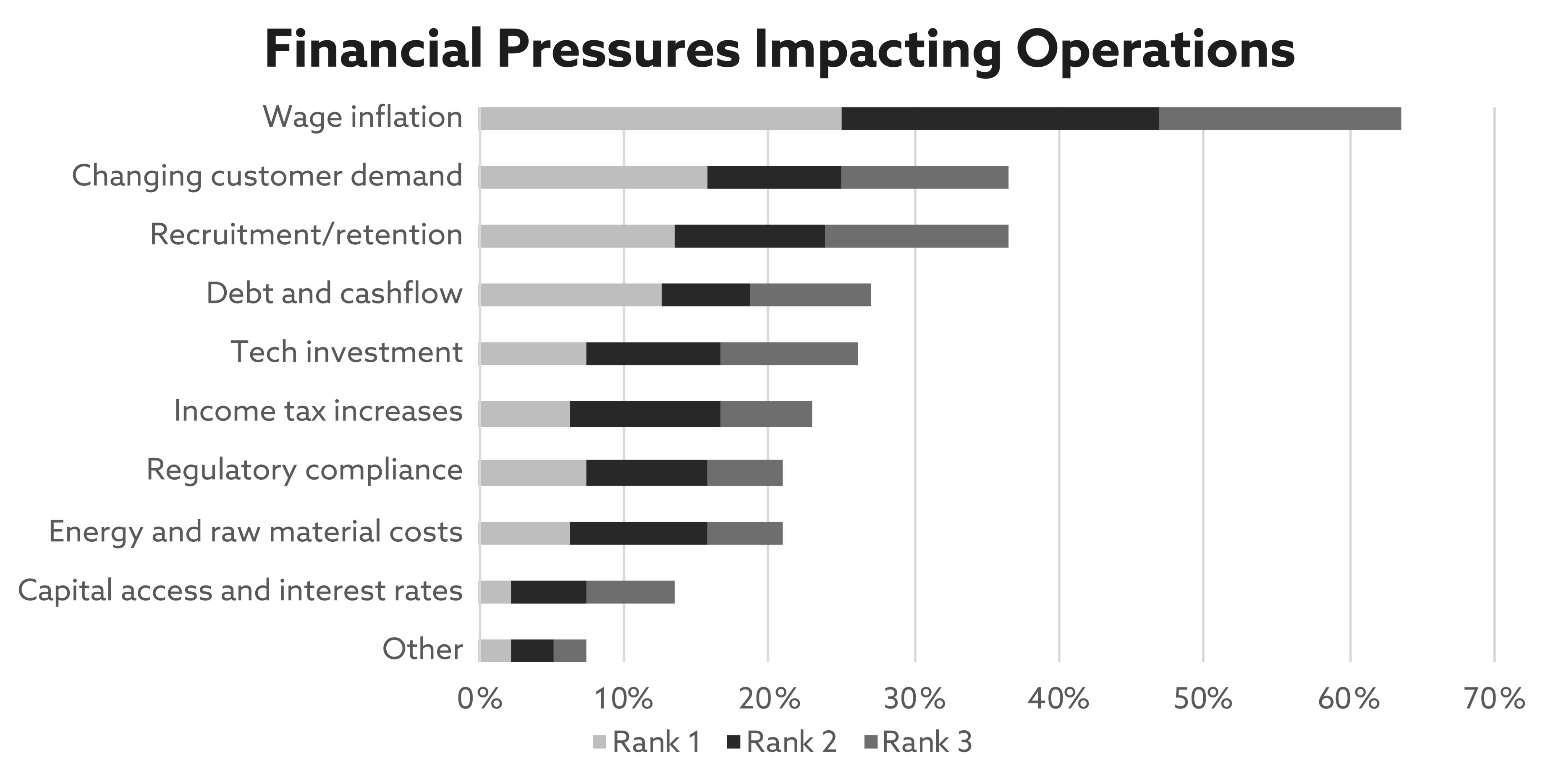
That matters because it changes what finance means in practice. It has become one of the mechanisms through which organisations determine what is possible, what is affordable, and what carries too much risk.
Wage inflation is forcing deeper commercial trade-offs
Wage inflation came through as one of the most persistent and difficult challenges organisations are facing. For labour-intensive businesses in particular, rising pay expectations are applying sustained pressure to margins. Yet the issue runs deeper than salary inflation alone. Recruitment and retention pressures continue to increase labour costs even in a softer market, while customer demand remains harder to predict. That combination makes pricing, profitability, and workforce planning more difficult to manage at the same time.
Several leaders described how this has forced a more fundamental rethink of pricing models, cost structures, and service delivery. Others spoke about the tension between retaining talent and maintaining long-term financial sustainability. These have direct consequences for capability, competitiveness, and operating resilience.
This is one reason financial pressure now feels structural rather than temporary. It is changing how organisations assess value, viability, and the trade-offs required to protect both.
Profitability is increasingly being treated as protection
One of the most notable shifts in the discussions was the move away from growth at all costs and towards a stronger focus on profitability as a form of protection. That distinction matters. Profit is increasingly being treated as the thing that gives a business room to invest, absorb shocks, and avoid reactive decisions when conditions tighten.
Jonathan Sharp, Co-founder of Cerelo Advisory, reflected that shift directly in discussion, capturing a wider move away from revenue growth alone and towards profitability as a source of resilience. That change also appears in organisational posture. Most businesses described their near-term stance as balanced: managing risk while still pursuing growth. Far fewer said they were taking an explicitly aggressive, defensive, or transformational approach, while a smaller group favoured selective investment through a more cautiously optimistic posture.
Three practical consequences follow from that. Investment decisions face tighter scrutiny. Operational efficiency carries greater weight. Underperforming business units attract less tolerance. In practice, that means initiatives are more likely to be judged through the lens of near-term financial value as well as longer-term strategic logic. That can improve discipline, but it also raises the pressure around future-facing investment.
Growth is still on the agenda — but the terms have changed
Financial pressure has changed is the way growth is being pursued. Leaders described a more cautious approach to investment in areas such as hiring, expansion into new markets, and capital expenditure. The research suggests that this caution is already affecting behaviour. Operational restructuring was the most common response to pressure, while delayed hiring and reduced investment also featured heavily. Pricing changes were widespread, and a meaningful proportion of organisations had made redundancies or postponed expansion plans. Only a relatively small minority reported making no strategic changes at all.
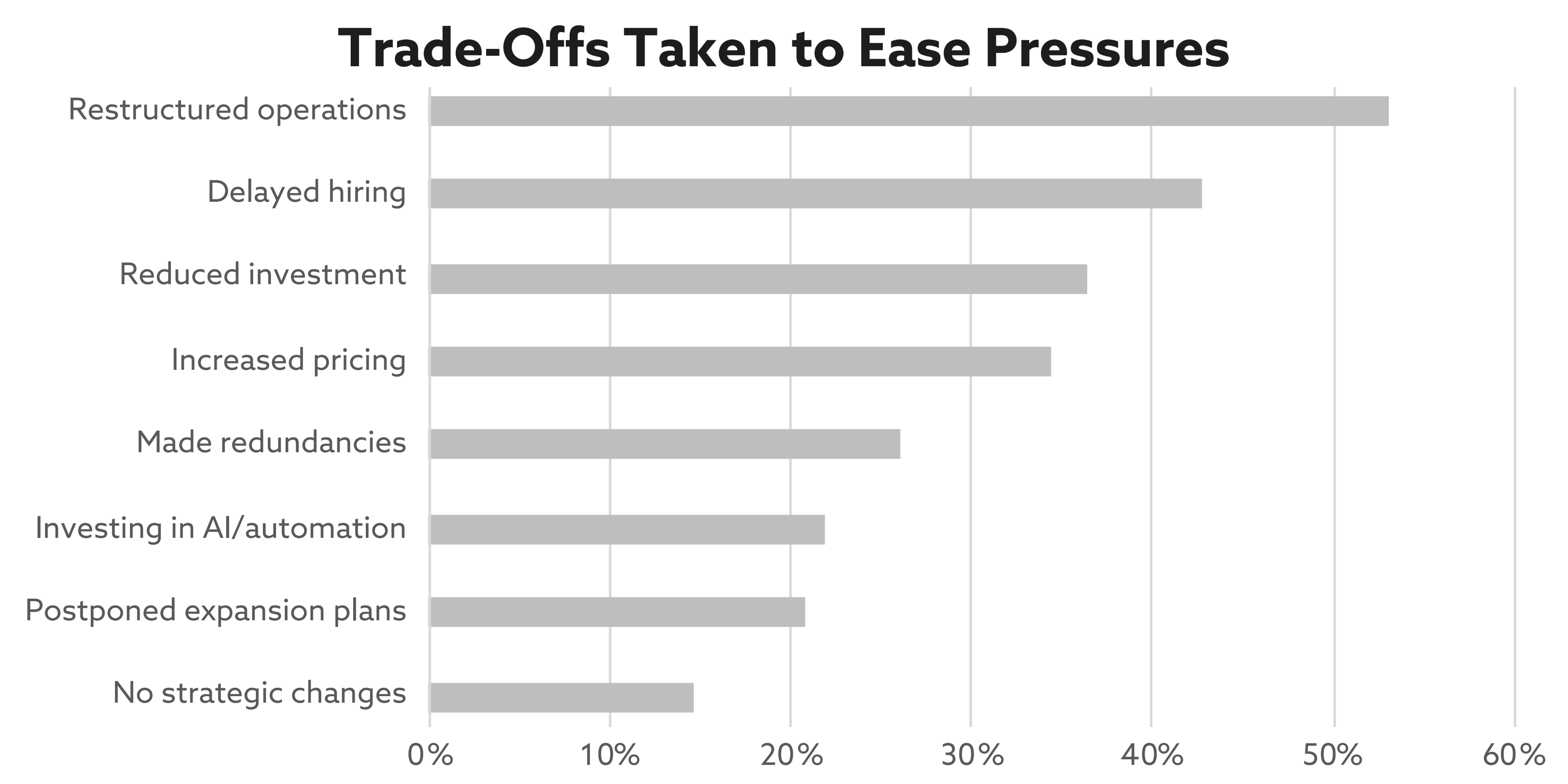
That pattern came through clearly in the roundtable examples. Eoghan Johnston of iamproperty described a significant hiring programme that had originally been planned for 2025 but was delayed until 2026 because of uncertainty around future demand and regulation. It is a strong example of how organisations are trying to preserve flexibility and reduce near-term risk before committing more heavily to expansion.
The challenge, of course, is that caution can become self-defeating. Delayed hiring, lower capital spend, and postponed growth decisions may protect current performance, but they can also narrow future capacity. This is the tension leadership teams are now managing most carefully: how to stay financially disciplined without quietly weakening the organisation’s ability to compete later.
Funding conditions are reinforcing more risk-averse behaviour
External finance is also shaping business behaviour more directly. Participants described a funding environment in which investors and lenders are taking a more cautious view, raising the standard organisations need to meet before capital is made available on acceptable terms. Although access to capital and interest rates do not rank as the most immediate pressures in the research, they remain highly relevant for businesses that rely on debt, refinancing, or growth capital to support expansion.
In that environment, organisations are under greater pressure to demonstrate clear profitability pathways, disciplined cost control, and sustainable business models. That is reinforcing a broader move towards self-sufficiency: stronger financial visibility, closer control of cash, and more emphasis on internally generated funding rather than external dependence.
Where lenders remain part of the picture, leaders also need a sharper view of liabilities, repayment terms, covenant headroom, and available cash. Finance is actively determining how much room the organisation has to make them.
Financial strategy is becoming more structural and more selective
The most forward-looking response to this environment is the redesign of financial strategy itself. Several contributors described a move towards more conservative budgeting, greater use of scenario planning, and more flexible cost structures. The wider research suggests this shift is already under way. Many organisations are restructuring operations, controlling hiring more closely, and making more selective investment decisions. At the same time, a smaller but notable group is still investing in AI and automation, suggesting that some leadership teams are trying to improve efficiency while also building future capability.
That distinction is important. In some businesses, financial discipline is creating a more deliberate approach to scalability, investment timing, and operational redesign. Leaders are trying to create room for targeted investment rather than abandoning it altogether.
This is also where finance and strategy are starting to converge more visibly. Rather than treating finance as a separate discipline, organisations are integrating cost, cash, and investment decisions directly into hiring, technology, customer strategy, and transformation planning. In tougher conditions, that alignment becomes essential.
The hardest question is where to cut — and where not to
One of the clearest tensions in the discussions was the balance between cost efficiency and organisational capability. Reducing cost can strengthen short-term financial performance, but it can also limit flexibility, slow growth, and weaken the organisation’s ability to adapt. Leaders described examples where cost-cutting reduced operational responsiveness, delayed hiring constrained future growth, and lower investment slowed transformation activity. In each case, financial discipline protected the present while putting longer-term capacity under pressure.
Some organisations are trying to manage that tension more selectively. The decision to keep investing in areas such as AI and automation, even at a relatively modest level, suggests there is growing recognition that not all spend is equal. Some expenditure can be reduced safely. Some capability needs to be protected because the cost of losing it will be felt later.
That is the real test of financial management in the current environment. It is about understanding which investments remain essential to competitiveness and which can genuinely be deferred without strategic damage.
What business leaders should take from this
The wider lesson is that financial pressure is one of the main forces shaping strategy itself. For leadership teams, that has several practical implications. First, financial discipline needs to be embedded within strategic decision-making, not treated as a later-stage constraint. Growth plans, transformation agendas, and hiring assumptions all need to be grounded in realistic views of cost, cash, and funding.
Second, short-term profitability and long-term capability have to be managed together. Underinvestment may not always show up immediately, but its consequences are often more damaging over time. Third, operating models need to become more flexible. In a tighter financial environment, rigid structures are harder to sustain and harder to adapt.
Finally, financial resilience is becoming a competitive advantage in its own right. The organisations most likely to perform strongly will not necessarily be the ones cutting hardest. They will be the ones able to manage cost pressure with discipline while continuing to protect the capabilities that matter most. Finance, in other words, is now one of the clearest indicators of whether strategy can be delivered at all.
Download the full report
This article draws on Nigel Wright Group’s wider research into business resilience and growth, alongside executive roundtable discussions with senior business leaders. To explore the full findings, broader market themes, and strategic implications in more detail, download the full report.
Building Resilient Growth Report
This report is based on Nigel Wright Group’s market research across the North of England, examining attitudes to business resilience and growth strategies at the start of 2026.

By submitting your details, you have read and understood our Privacy Notice