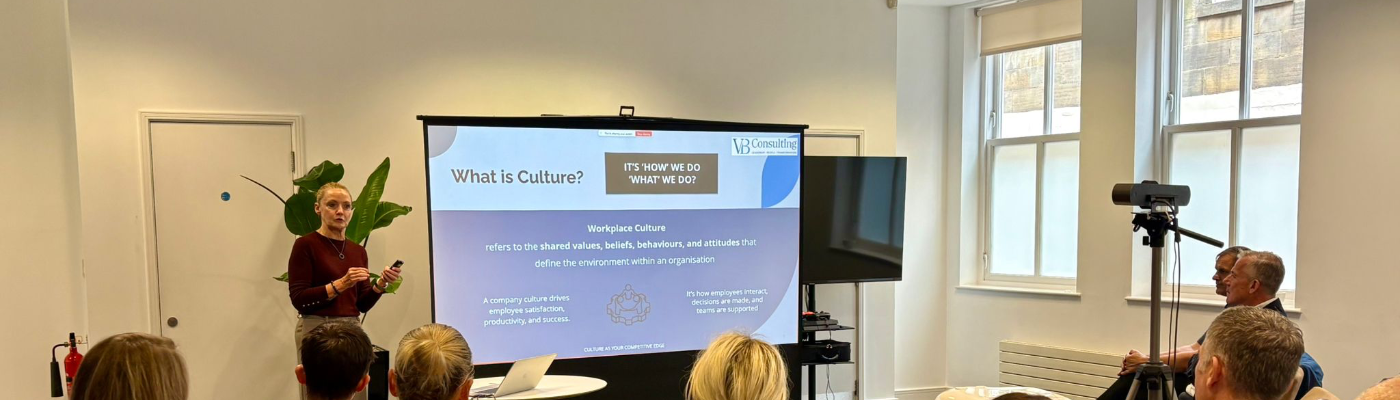
At Nigel Wright Group’s recent Culture as a Competitive Advantage event, senior leaders from the manufacturing sector gathered virtually across the UK and at our offices in Newcastle and Leeds to explore how culture can make, or break, business performance. The discussion was introduced by Lisa Taylor, Associate Director at Nigel Wright, before leadership coach Vicky Brockley delivered a powerful presentation on why culture is never optional, and how leaders can turn it into a true competitive edge.
The manufacturing challenge
Lisa Taylor opened the seminar by reflecting on her time supporting manufacturing businesses. She highlighted how the industry has endured relentless pressures in recent years — from COVID-19, semiconductor shortages and rising energy costs, to geopolitical conflict, Brexit, and the knock-on effects of taxation and labour market uncertainty.
Manufacturers, she noted, have largely responded in two ways. Some are investing in automation and new technologies like AI. Others are doubling down on people, recognising that many processes remain reliant on manual skill and dexterity. This is where culture comes into play. Businesses are increasingly focused on building high-performing teams and ensuring leaders can harness both cultural alignment and productivity to drive growth.
Against this backdrop, Lisa introduced the keynote speaker, Vicky Brockley, whose career spans senior roles at Black & Decker, Asda, and manufacturing turnarounds, before moving into leadership coaching. Known for her passion for people and culture, she was perfectly placed to share practical insights from the front line.
Culture: how we do what we do
Vicky began by redefining culture not as abstract “values on a wall,” but as the lived behaviours, beliefs, and interactions that shape how work gets done. In her words, it is “how we do what we do.” To illustrate, she told the story of John F. Kennedy’s 1962 visit to the Kennedy Space Center, where a janitor described his job as “helping to put a man on the moon.” For Vicky, this story embodies true alignment: when every individual understands how their role contributes to the bigger mission.
The evidence for cultural investment is compelling. Companies that prioritise culture can outperform their peers by 20%–30%, with 70% fewer safety incidents, 21% higher profitability, significantly lower turnover, and up to four times greater shareholder returns. These results, Vicky argued, are achieved not by chasing processes alone, but by unlocking discretionary effort, trust, and engagement across the workforce.
Case studies in transformation
Drawing on her own career, Vicky shared two powerful examples.
The first was a technical site delivering just a 3% return on sales and facing closure. With a disengaged workforce, high disciplinaries, and a bullying culture, the outlook was bleak. Within 18 months, however, Vicky helped transform performance to a 24% return on sales, lifting EBITDA from £800,000 to £5 million. The secret? Not new machinery or products, but honest communication, listening to employees’ frustrations, fixing overlooked basics, and building trust.
The second involved a merger between two long-time competitors. Despite profitability before the merger, together they spiralled into losses, as employees clung to old allegiances, refused to wear shared uniforms, and even sabotaged each other’s work. By shifting focus from metrics to values and behaviours, Vicky steered the teams towards respect and cooperation, creating a £4 million swing in performance without changing a single product line.
Her conclusion was clear: culture is not theory. With the same people, the same tools, and the same materials, businesses can achieve radically different results if leaders commit to shaping behaviours and alignment.
The Steves, Seans, and Jesses of the workplace
Vicky went on to humanise culture through a series of character studies.
- Steve is the long-serving, reliable worker who rarely speaks up. Managers often dismiss him as disengaged, yet when encouraged, he can become a source of vital insights, spotting inefficiencies, risks, and opportunities others overlook.
- Sean is the brilliant problem-solver whose knowledge can transform projects — but his arrogance and lack of empathy alienate colleagues. He represents the danger of results without sustainability, reminding leaders that toxic behaviours can’t be excused just because they deliver short-term wins.
- Jess is the underestimated newcomer. Initially overlooked because of unconscious bias, she went on to shine once given a chance, quickly rising from apprentice to trusted contributor. Her story is a reminder that fresh perspectives often come from where leaders least expect them.
Finally, Vicky warned against over-reliance on “the machine.” Investment in technology is tempting, but competitors can buy the same kit. The true differentiator lies in the people who operate, maintain, and interpret that technology. Their training, judgement, and engagement determine whether investment delivers results.
Why organisations get it wrong
Despite the evidence, many organisations still stumble when it comes to culture. Vicky identified common mistakes:
- Treating values as “wallpaper” — slogans on posters with no lived meaning.
- Failing to review or realign culture after major shifts such as COVID.
- Ignoring micro-cultures or excusing toxic high performers.
- Focusing incentives purely on output rather than behaviours and teamwork.
- Assuming people are happy, or avoiding feedback for fear of hard truths.
- Delegating culture to HR, as if it were “soft stuff,” rather than owning it as a leadership responsibility. In truth, managing culture is anything but soft — it is complex, demanding work, which is precisely why it so often gets overlooked or pushed down the list of priorities.
Her stark reminder: the culture of any organisation is shaped by the worst behaviour a leader is willing to tolerate.
Rebuilding culture: the leadership challenge
So how can organisations get back on track? Vicky laid out a framework:
- Reset vision and values and admit honestly where culture has slipped.
- Invest in leadership training, particularly for technical managers who may lack people-management skills.
- Communicate openly, owning past mistakes and reinforcing expectations.
- Listen to employees as individuals, recognising that different generations and roles have different needs.
- Align recruitment and rewards to culture as much as technical ability.
- Celebrate wins and enforce accountability consistently across all levels.
- Be patient and consistent, treating culture as an everyday practice, not a slogan.
For Vicky, culture is what sets employers apart in today’s battle for talent. People don’t just choose jobs for money; they stay where they feel valued, included, and heard.

Shaping culture, not being shaped by it
Closing her talk, Vicky reminded attendees that culture is about unlocking potential. Steve, Sean, and Jess each show that beneath every stereotype lies untapped value — provided leaders take the time to understand and connect the pieces of the human jigsaw.
Her final message was simple but urgent: culture is not optional. It is the true competitive edge. If leaders fail to shape it, culture will shape them — often in ways they least expect.
If you would like to explore opportunities to build your competitive advantage through cultural improvements, Vicky Brockley of VB Consulting can be contacted at vicky@vickybconsulting.com