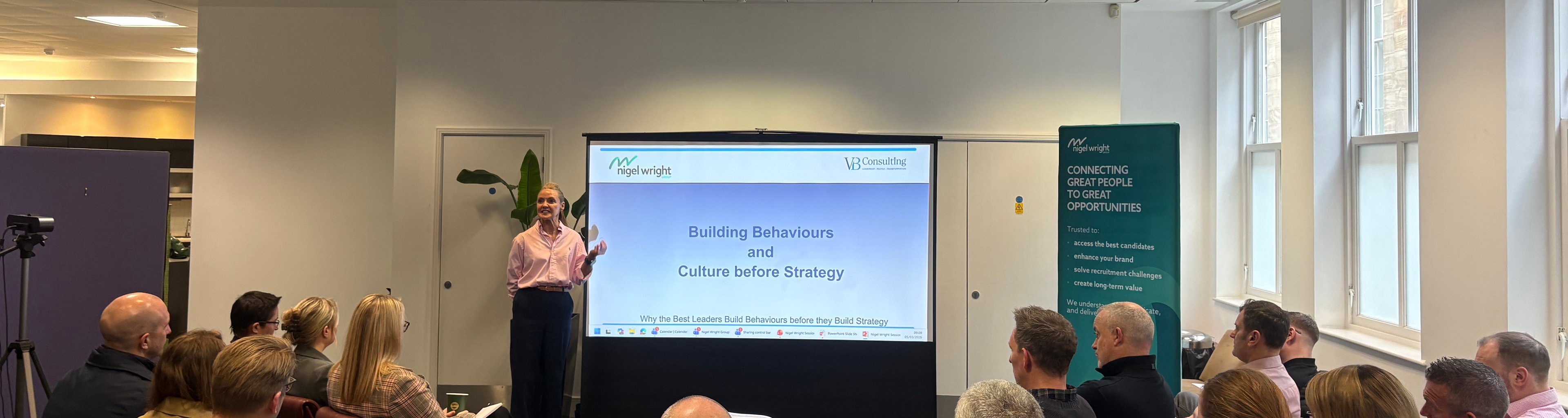
Building Behaviours and Culture Before Strategy
At a recent Nigel Wright leadership event, senior decision-makers from across the North of England gathered in Newcastle and Leeds alongside a wider online audience to discuss an issue central to organisational performance: the relationship between culture, behaviour, and strategy. The session formed part of Nigel Wright Group’s Connecting Great Manufacturers programme, a series of events designed to bring together leaders from across the manufacturing sector to share insights and experiences. With the industry facing sustained pressures in recent years, including supply chain disruption, rising energy costs, labour market constraints, and wider geopolitical uncertainty, many manufacturers are exploring new ways to strengthen culture and engagement while maintaining productivity.
The event featured Vicky Brockley, founder of Vicky B Consulting and former Vice President of UK Operations at Smurfit Westrock. This was the second session Nigel Wright has hosted with Vicky following a well-received seminar delivered in 2025. Drawing on more than 30 years of experience leading business turnarounds across manufacturing, logistics, and supply chain environments, she shared a clear challenge for leaders seeking sustainable growth, arguing that organisations focusing heavily on strategy without aligning behaviours and culture often struggle to deliver the outcomes they expect.
This perspective reflects a well-known insight from leadership consultant James C. Collins in his book Good to Great, referenced at the beginning of the session, which suggests that great organisations rarely start with strategy and instead begin with people, ensuring the right individuals occupy the right roles and share common values before determining the organisation’s direction.
Why Behaviours Matter More Than Strategy
Many organisations invest considerable time and resources developing strategic plans, with leadership teams analysing competitors, exploring market opportunities, setting ambitious targets, and defining transformation programmes designed to improve performance. Despite this effort, strategies frequently fall short of expectations, prompting leaders to question whether the plan itself was flawed.
According to Vicky, the challenge rarely lies in the strategy. In many cases the issue stems from behavioural and cultural misalignment, because inconsistent leadership behaviour can create confusion across teams, weaken accountability, and slow down decision-making across the organisation.
When that situation develops, teams begin moving in different directions, priorities compete for attention, and high performers may disengage after recognising a gap between what leaders say and what they actually do in practice. Under these circumstances businesses often return to the strategy in search of answers, although the deeper issue may lie in how effectively the organisation is aligned to deliver it.
The Culture You Tolerate Is the Performance You Get
One of the most striking ideas from the session focused on the way culture forms within organisations, not as an abstract concept but through the everyday behaviours that leaders reward, ignore, tolerate, or challenge.
Vicky summarised this clearly by stating that the culture leaders tolerate ultimately determines the performance they receive.
Many leadership teams recognise this pattern when reflecting honestly on their own businesses, because almost every organisation has allowed behaviour to continue that contradicts the values it claims to promote. Sometimes the example involves a high-performing individual whose conduct damages collaboration, in other cases it may involve a long-standing manager whose habits remain unchallenged due to tenure or experience, while occasionally a senior leader may unintentionally weaken standards by acting in ways that contradict expectations elsewhere in the business.
Allowing those behaviours to continue sends a powerful signal across the organisation, since employees quickly recognise that stated values are not always non-negotiable, a realisation that gradually weakens trust and undermines performance.
Culture Is Created by Leadership
Another theme explored during the event centred on the role leadership plays in shaping organisational culture. Rather than sitting within HR or appearing as a separate initiative, culture emerges from everyday leadership behaviour.
Every meeting, decision, and interaction contributes to the cultural environment of a business, with expectations set through consistent behaviour rather than slogans or statements on a wall.
Employees observe those signals carefully, particularly when leaders reward collaboration, accountability, and transparency, because those actions reinforce the behaviours the organisation wishes to see more often. Conversely, when leaders overlook conduct that contradicts these principles, employees naturally adapt their own behaviour to reflect what they believe is truly expected.
Cultural alignment therefore begins with the leadership team itself, since visible consistency at the top of the organisation plays an important role in shaping behaviour throughout the wider workforce.
A Real-World Example of Strategy Failure
During the discussion Vicky shared an example from her career that highlighted how behavioural misalignment can undermine an otherwise sound strategy.
Following an acquisition, an organisation merged two competing businesses onto a single site and introduced a new SAP system alongside operational improvement plans designed to increase efficiency. Leaders expected the combined business to deliver an additional £4 million in profit, yet performance deteriorated and the operation began losing money.
When Vicky reviewed the situation, the strategy itself appeared logical and well structured, with plans focused on improving stock control, strengthening procurement processes, increasing use of the new system, and raising quality standards across the operation.
Closer examination revealed a different challenge, because employees from the previously competing businesses felt reluctant to collaborate, teams frequently blamed one another when operational issues appeared, several managers continued using spreadsheets instead of the new system due to a lack of trust in the change, and this combination of behaviours gradually weakened the effectiveness of the strategy.
Progress only began once leadership redirected attention towards behaviour and culture, encouraging collaboration, reinforcing accountability, and setting clearer expectations for how teams should work together.
Getting the Right People in the Right Roles
Another point raised during the conversation concerned the importance of placing talented individuals in roles that match their capabilities.
Businesses often promote technical experts into leadership positions without considering whether those individuals possess the skills required to lead teams or think strategically about the future of the organisation. A highly capable engineer, for instance, may excel at diagnosing operational problems and restoring equipment quickly, yet feel less comfortable when asked to manage people, oversee budgets, or contribute to long-term planning discussions.
Such situations do not necessarily indicate that the individual is unsuited to the organisation, although they may highlight that the role itself does not align with their strengths.
Honest conversations around capability, behaviour, and fit therefore play an important role in ensuring individuals contribute effectively, particularly when organisations aim to deliver ambitious strategies.
Listening to What Engagement Data Is Telling You
Employee engagement insights also formed an important part of the discussion, particularly when leaders consider how to translate survey results into meaningful cultural insights.
Engagement surveys often reveal patterns that reflect deeper cultural challenges within an organisation, including low trust levels linked to inconsistent leadership behaviour, uncertainty around decision-making connected to misalignment within the executive team, or limited collaboration resulting from conflicting objectives between departments.
Rather than responding with additional initiatives or communication campaigns, leaders sometimes benefit from examining the behaviours that contribute to these outcomes, since cultural improvement often depends on consistent leadership behaviour rather than new programmes.
Defining the Behaviours That Drive Performance
When organisations seek to influence culture, leaders frequently begin by identifying behaviours that matter most for the future success of the business.
Examples may include accountability, collaboration, ownership, or transparency, each of which requires clear definition so employees understand what those behaviours look like in everyday situations.
Leadership teams therefore play a critical role in explaining expectations through practical examples, describing how those behaviours appear in meetings, conversations, and decision-making processes across the organisation.
Visible leadership behaviour then reinforces those expectations, because employees observe how consistently standards apply across teams, roles, and levels of seniority.
The Biggest Lever Leaders Can Pull
Throughout the event Vicky emphasised that culture should not be considered a soft organisational topic. Behaviour and culture shape how effectively teams execute plans, influence how quickly organisations adapt to change, and determine whether strategies translate into measurable results.
When culture shapes behaviour and behaviour determines execution, leadership alignment becomes one of the most significant levers available to organisations pursuing growth, transformation, or operational improvement.
Before revisiting strategy, leadership teams may therefore find value in asking a simple question about their organisation: Are we behaviourally aligned to deliver it?
When the answer suggests gaps remain, addressing those behavioural and cultural factors often becomes the starting point for meaningful progress.