
Artificial intelligence has moved quickly from an emerging topic to a boardroom priority. Leadership teams increasingly recognise its potential to improve efficiency, strengthen decision-making, and support growth. Yet AI maturity remains uneven across most organisations.
Many businesses are investing in new tools while still working around legacy systems, inconsistent data, limited internal capability, and uncertainty about how far or how fast adoption should go. The result is real progress, but patchy integration.
This article draws on Nigel Wright Group’s wider research into business resilience and growth, alongside executive roundtable discussions with senior business leaders. The findings show that AI is already influencing productivity, cost efficiency, customer experience, and operational performance. They also suggest that AI remains more visible in pilots and isolated use cases than in fully integrated, business-wide capability.
AI maturity depends on whether AI has been integrated into systems, decisions, leadership, workforce planning, and day-to-day operations in ways that create practical commercial value. Many organisations are still at an early stage of that process.
Key Questions Answered
What challenges do organisations face when adopting AI?
Most face a combination of capability shortages, legacy infrastructure, weak data foundations, and uncertainty about how to scale AI beyond pilot activity.
How is AI being applied in business operations today?
Organisations are using AI for sentiment analysis, automation, customer service support, translation, operational monitoring, and faster data-led decision-making.
How can AI improve efficiency and decision-making?
It can increase productivity, reduce friction, strengthen customer understanding, highlight process inefficiencies, and improve the speed and quality of operational judgement.
What capabilities are required to implement AI successfully?
Successful adoption depends on data quality, systems integration, technical and change capability, leadership clarity, and enough confidence across the organisation to adopt AI responsibly and at scale.
Most organisations have started with AI, but few have reached maturity
AI adoption has moved well beyond theory. Many organisations are already using it in specific parts of the business, yet relatively few have progressed beyond targeted experimentation.
Around two-thirds describe themselves as piloting AI in isolated functions, making this by far the most common stage of maturity. A much smaller group say they are scaling AI across multiple business areas, while only a limited minority report that it is embedded in core strategy and operations. At the other end of the spectrum, a similarly small proportion say they have no current use at all.
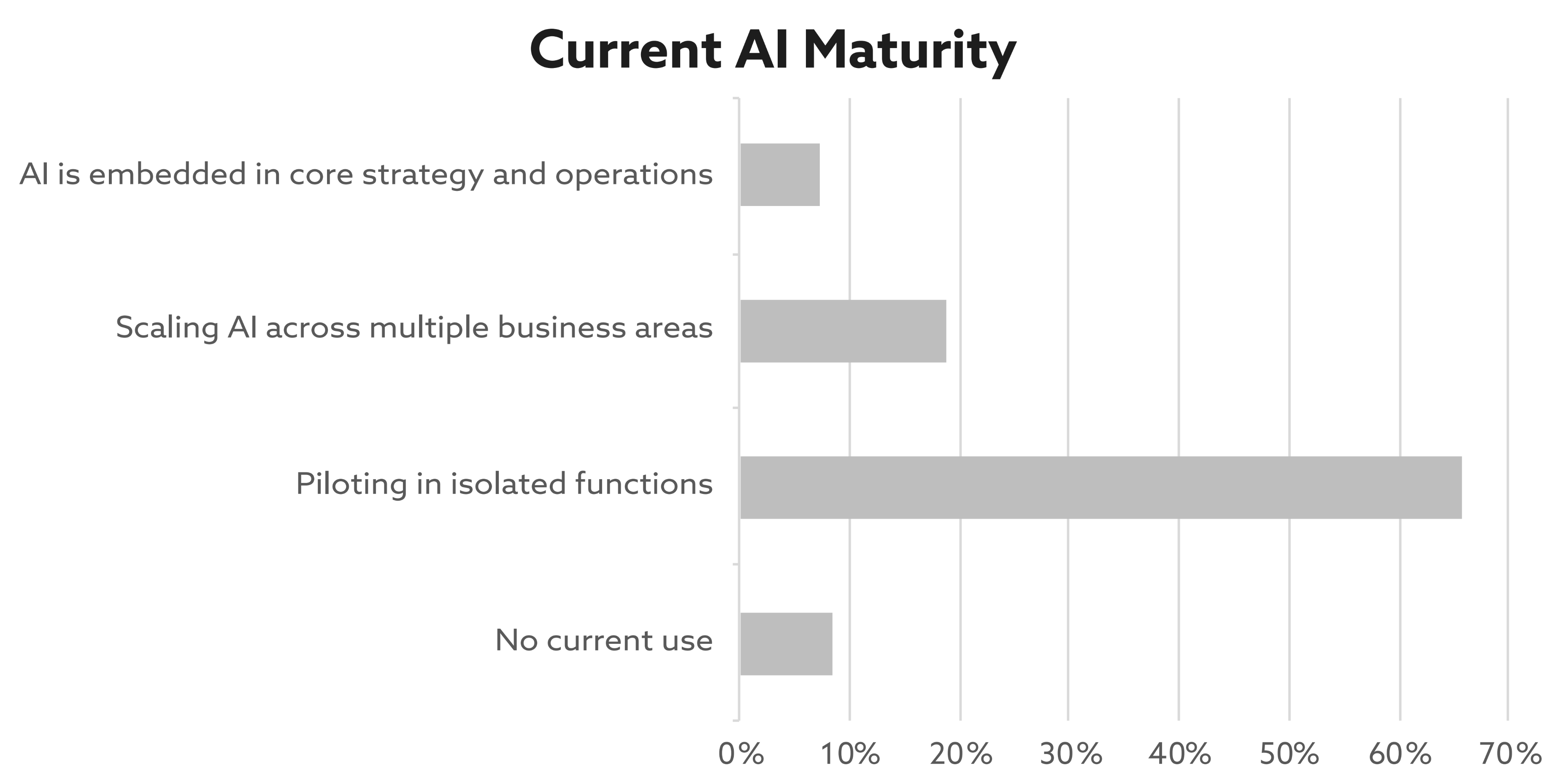
AI is therefore present in most organisations, but usually in a contained or exploratory form rather than as a fully integrated capability.
Examples discussed during the roundtables included sentiment analysis across customer interactions, automation of routine administrative work, AI-assisted communication and decision-making, and early-stage use of robotics and physical automation. As one participant put it, despite visible progress, “we are not even in first gear” in terms of understanding AI’s full potential.
The technology is no longer hypothetical. The operating models, systems, and capabilities required to make it fully effective are still developing.
The biggest barriers are structural
AI adoption is being held back less by a lack of interest than by the conditions needed to make it work.
Mark Simpson, Nigel Wright Group’s Executive Director and facilitator of the discussions, highlighted the difficulty many organisations face when introducing new AI capability while relying on systems that were never designed to support advanced analytics. Participants repeatedly returned to the importance of structured, accessible, and reliable data. Without it, AI cannot produce meaningful outcomes.
The research reflects this view. The most significant barrier to adoption is a lack of internal AI expertise and talent. Legacy systems and infrastructure follow closely, alongside data quality and governance issues.
Together, these three barriers outweigh concerns such as implementation cost, uncertainty around return on investment, or organisational resistance to change.
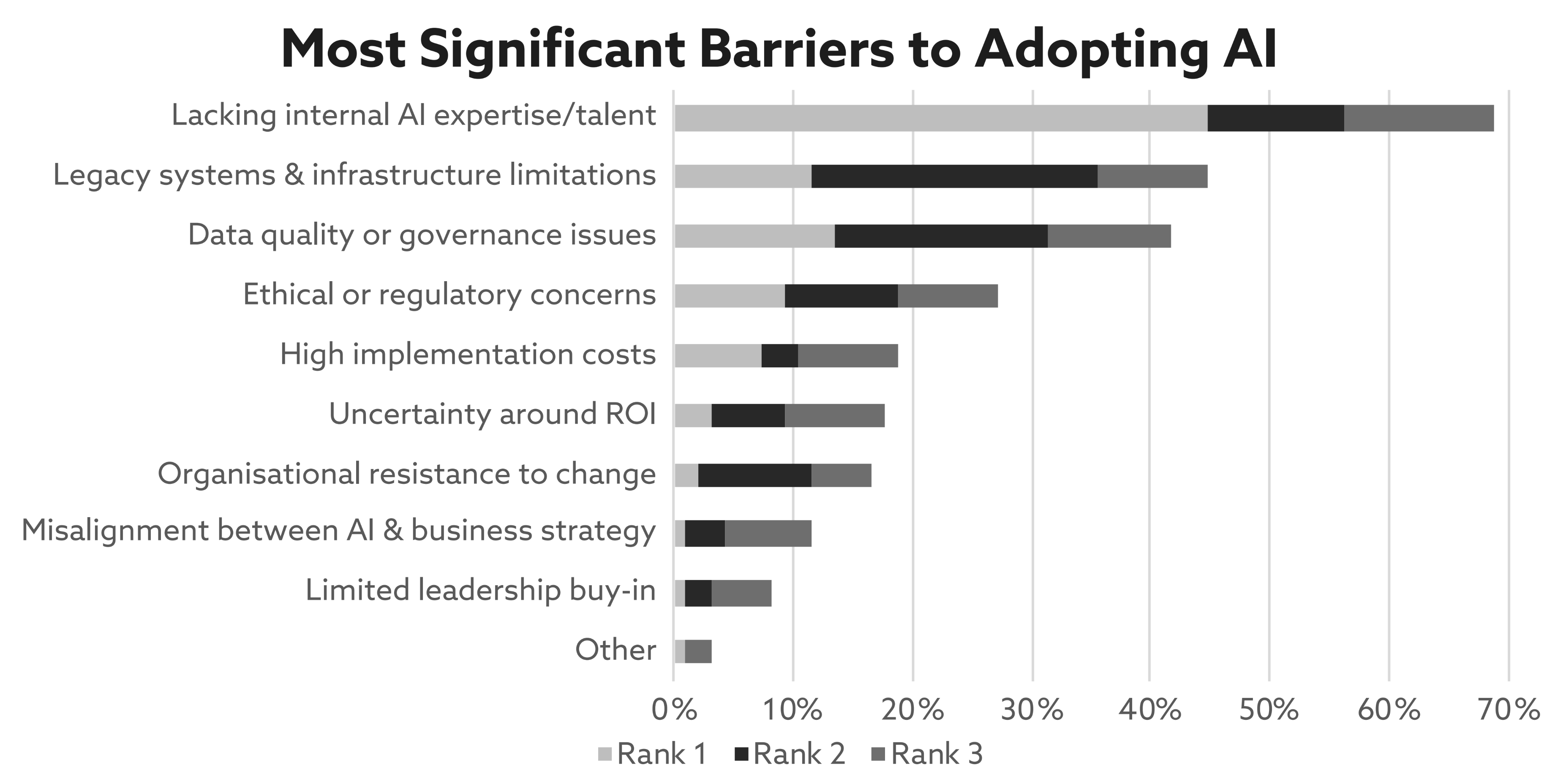
Fragmented systems, inconsistent data structures, and limited integration between platforms are among the main reasons why many businesses remain stuck at the pilot stage. The ambition exists, but the foundations required to scale adoption are not always in place.
The value of AI is already showing up in practical business outcomes
Roundtable participants described a growing number of applications already delivering measurable value.
Rory McKeand, Chief Executive Officer at TSG, explained how large language models are being used to analyse customer sentiment across multiple interactions. This turns unstructured communication into actionable insight, giving organisations a more scalable way to understand customer experience and identify issues in real time.
Other examples followed a similar pattern. One participant explained how AI is supporting frontline staff by providing instant access to information during customer interactions. This reduces the need for internal escalation and improves resolution times.
Matthew Chapman, Chief Executive of SBFM, described the use of AI tools to improve communication between frontline employees and head office. Language translation has improved both productivity and customer service outcomes.
The wider research shows that increased productivity is the most significant effect organisations associate with AI, followed by cost efficiency and enhanced customer experience. Faster decision-making also ranks strongly, while a smaller but still notable group identify role redesign and new business model creation as emerging effects.
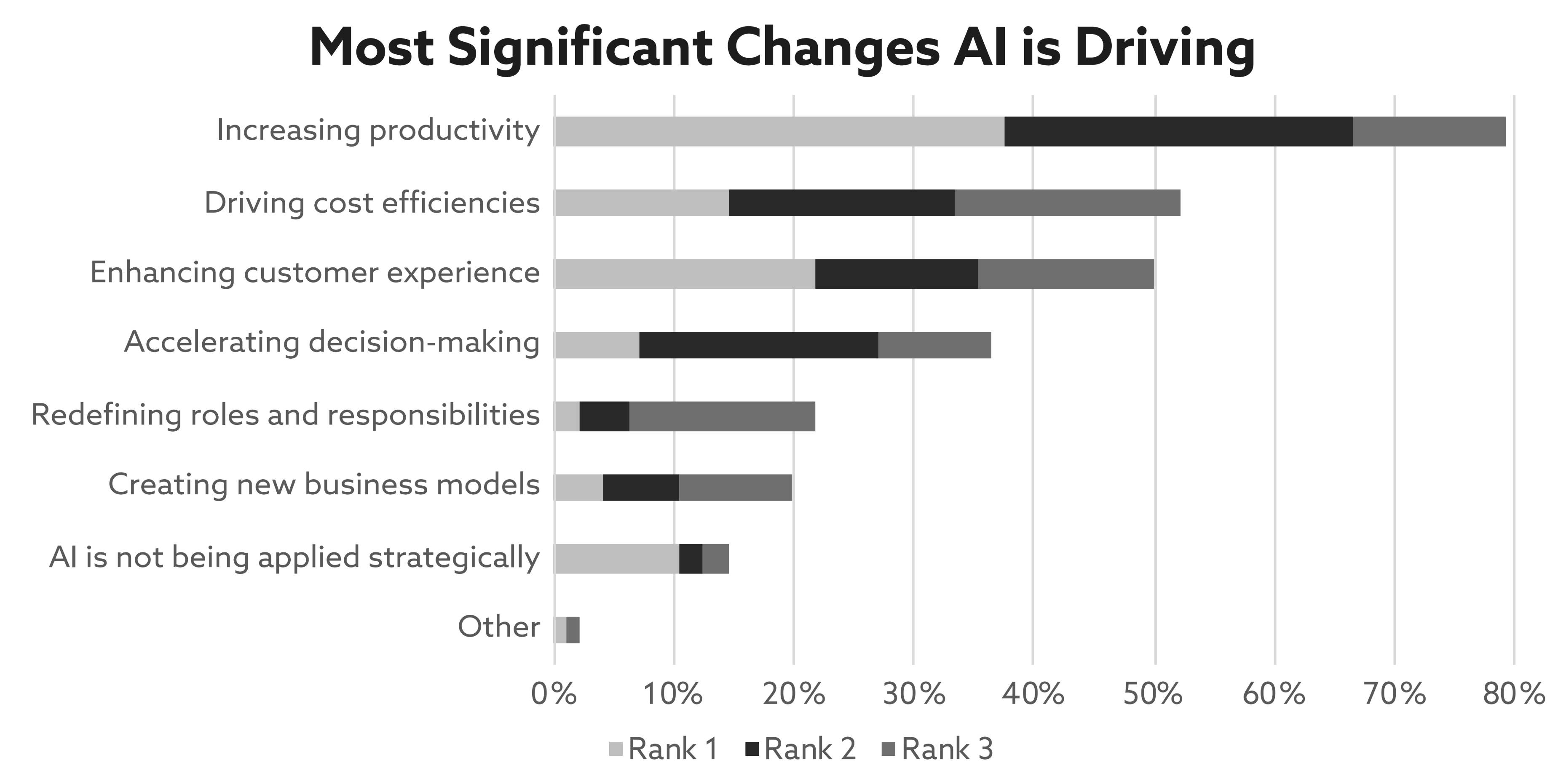
AI is already creating practical value, even where organisational maturity remains relatively low. At this stage, the return is often coming from lower friction, better productivity, improved customer understanding, and quicker access to insight rather than dramatic business-wide change.
Automation is changing the shape of work
The effect of AI on job design and workforce structure was another recurring theme.
Participants highlighted that automation is already reducing the need for some transactional work while increasing demand for oversight, judgement, and decision-making capability. One contributor described how optical character recognition and automation had removed a significant share of manual administrative work from legal and financial processes.
Elsewhere, organisations are using AI to streamline customer service activity and reduce repetitive tasks.
More advanced developments are also being explored. Matthew Chapman referenced ongoing work involving humanoid robotics in cleaning and facilities management, illustrating the potential for physical automation alongside digital change.
Automation will reshape how work is organised and where value is created, even though that redesign remains at an early stage in many organisations.
AI maturity cannot be judged only by the number of tools deployed. It also depends on whether roles, responsibilities, and workflows are being adapted so that the technology creates value rather than simply sitting alongside existing processes.
AI is already improving decision-making, but only where organisations can act on the insight
AI is increasingly being used to improve decision quality and operational performance.
Participants described how it can identify patterns in large datasets, expose process inefficiencies, and support faster, more informed decisions. In manufacturing, for example, organisations are using technology to monitor energy consumption and operating performance across production lines. This creates immediate visibility and supports continuous improvement.
In other settings, data-led tools are helping businesses understand customer behaviour, resource allocation, and market activity in greater detail.
Alongside productivity and cost efficiency, faster decision-making is one of the most frequently identified effects of AI adoption. For many organisations, AI is not yet changing the whole business, but it is already improving the speed and quality of operational judgement.
Several leaders also stressed that these benefits depend on how effectively the technology is connected to the wider organisation.
Value emerges when businesses can interpret the insight, connect it to decisions, and act on it consistently. AI can support better judgement only when the surrounding systems, skills, and decision rights are able to absorb what it reveals.
The leadership and culture challenge may be just as important as the technology challenge
The human response to AI adoption remains a significant barrier.
Across both discussions, participants highlighted fear and resistance among employees. In professional services, some people initially viewed AI as a direct threat to core roles, creating uncertainty and disengagement.
That perspective is beginning to shift. More professionals now see AI as a tool that can enhance human capability rather than simply replace it.
Sarah Hex of Clarion pointed to the way technology is already changing junior workloads in fields such as accountancy, where fewer graduate-level tasks may be required over time. AI adoption changes not only systems and outputs, but also the shape of work and the routes through which people develop their careers.
Leadership attitudes are evolving alongside those changes. The largest group describes itself as experimenting with intent, while many others remain open but uncertain. Smaller groups say they are strategically committed or transformational, and only a very small minority appear cautious and reactive.
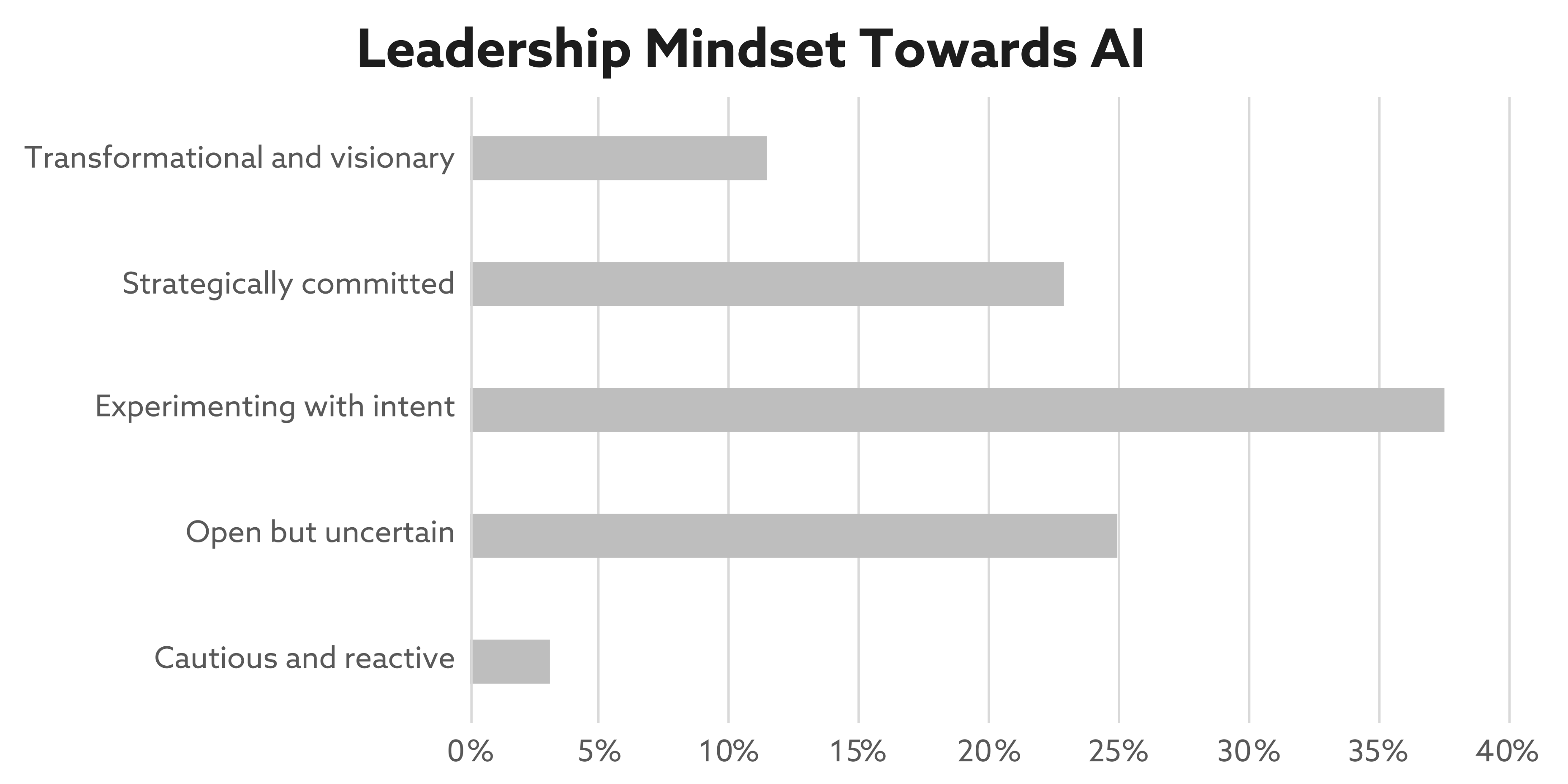
Many leadership teams are therefore engaged with AI but have not yet settled how far or how fast they want to go.
Leaders need to provide enough clarity for employees to understand how roles may evolve, while avoiding false certainty in an area that continues to change quickly.
AI maturity depends on broader leadership capability
AI adoption is driving the creation of new roles and a broader shift in capability requirements.
Participants referenced positions such as Heads of Transformation, Data and Analytics Leaders, and AI-focused leadership roles. Many of these positions did not exist in organisations a decade ago. Their emergence reflects the need for dedicated capability to lead digital and AI-enabled change.
The research also suggests that the leadership qualities most likely to matter over the next five years are broad rather than narrowly technical.
Strategic vision ranks highest, followed by empathy and people leadership, adaptability, and commercial acumen. Influence, digital fluency, and ethical judgement are also seen as important.
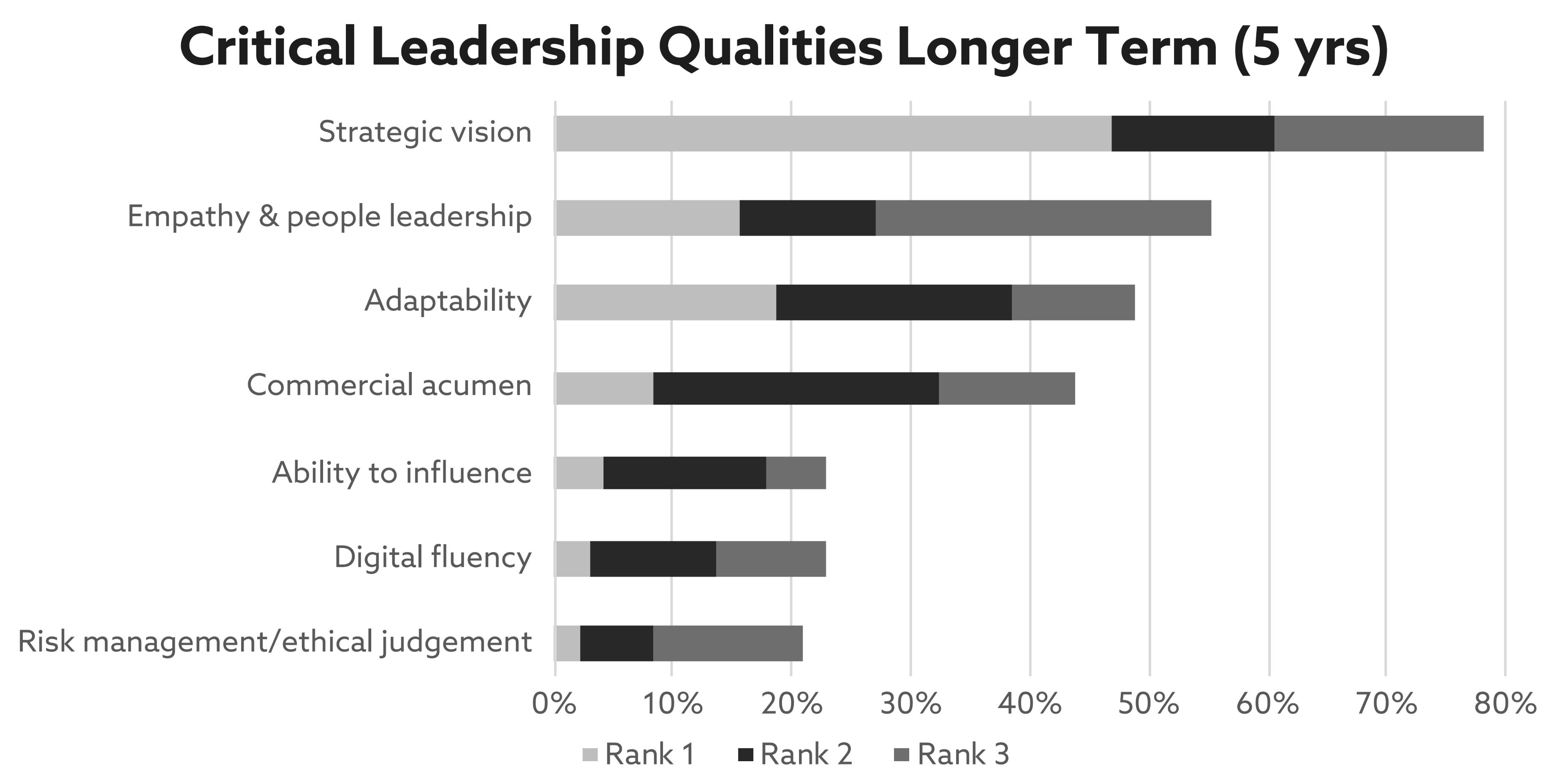
This combination suggests that AI maturity depends on more than understanding what the technology can do. Leaders must be able to manage uncertainty, bring people with them, and translate technical potential into commercially grounded action.
Access to tools is not the main differentiator. Greater value comes from integrating those tools into decisions, behaviours, governance, and operating models.
The risks of AI increase when adoption outpaces governance
The discussions also highlighted several risks and limitations.
Participants raised concerns about over-reliance on AI-generated outputs, inaccurate or misleading information, and growing volumes of low-quality automated communication.
Sarah Tahamtani of Clarion explained that AI-generated documents in legal settings can appear credible while still requiring detailed human review to confirm their accuracy. In other contexts, organisations are seeing AI used to generate complaints or claims at scale, increasing administrative burden rather than reducing it.
The research identifies wider concerns, including ethical and regulatory issues, uncertainty around return on investment, resistance to change, and misalignment between AI initiatives and business strategy. These rank below capability and systems problems, but become more significant as organisations progress from experimentation to wider deployment.
Governance must strengthen as adoption expands.
Organisations need clear policies covering data protection, cyber risk, human oversight, intellectual property, and the review and validation of AI-generated outputs.
Procurement discipline also matters, particularly where AI or automation tools are supplied externally. Contracts may need to address service levels, data use, liability, exit arrangements, and future changes to the technology.
The risk lies not only in adopting AI badly, but in scaling it without enough oversight, accountability, or control.
What business leaders should take from this
AI is already becoming an important enabler of growth, efficiency, and better decision-making. Yet maturity remains uneven and at an early stage for most organisations.
The dividing line is whether they can build the systems, data foundations, leadership confidence, and workforce capabilities needed to put that potential to work at scale.
Foundational issues such as data quality, systems integration, and internal capability need to be addressed before AI can deliver sustainable value.
Investment in technology must be matched by investment in people, particularly leaders and specialists who can turn technical possibility into commercial outcomes.
The cultural dimension cannot be treated as secondary. Leaders need to manage uncertainty, explain how roles may change, and build confidence in the purpose behind AI adoption.
AI should also be treated as an ongoing organisational change programme rather than a one-off technology initiative. The pace of development means businesses need to keep testing, adjusting, and refining their approach as both the technology and the commercial context evolve.
Maturity is reached when AI becomes part of operations, leadership, workforce design, and decision-making in ways that produce repeatable business value.
Download the Full Report
These findings form part of Nigel Wright Group’s wider research into business resilience and growth, supported by executive roundtable discussions with senior business leaders.
Download the full report to explore the broader market themes, research findings, and strategic implications in more detail.
Building Resilient Growth Report
This report is based on Nigel Wright Group’s market research across the North of England, examining attitudes to business resilience and growth strategies at the start of 2026.

By submitting your details, you have read and understood our Privacy Notice