

Talent shortages have become one of the most widely discussed challenges facing the consumer sector. Companies are investing in recruitment campaigns, strengthening their employer brands, increasing compensation, and expanding their search for talent. Yet, without extra effort, the outcome is often the same: critical positions remain unfilled, teams are stretched, and growth initiatives progress more slowly than planned.
But what if the real challenge is not the talent market itself?
The findings of our European Business Resilience & Growth Report 2026 suggest a more nuanced reality. The data indicates that many organisations are not primarily struggling because candidates do not exist. Instead, they face a more fundamental challenge: building the capabilities and structures required to manage growth, transformation, and increasing complexity. Talent shortages are often simply the most visible symptom of a deeper issue.
Talent Shortages Are Not an Isolated Recruitment Problem
When individual professions become difficult to hire for, market conditions can often provide a reasonable explanation. The picture looks very different, however, when shortages affect almost every level of an organisation.
According to the report, 78% of organisations identify mid-level roles as their most significant talent bottleneck. At the same time, 71% report shortages of technical specialists, 67% struggle to attract entry-level talent, while senior and executive-level shortages affect 65% and 62% of organisations respectively.
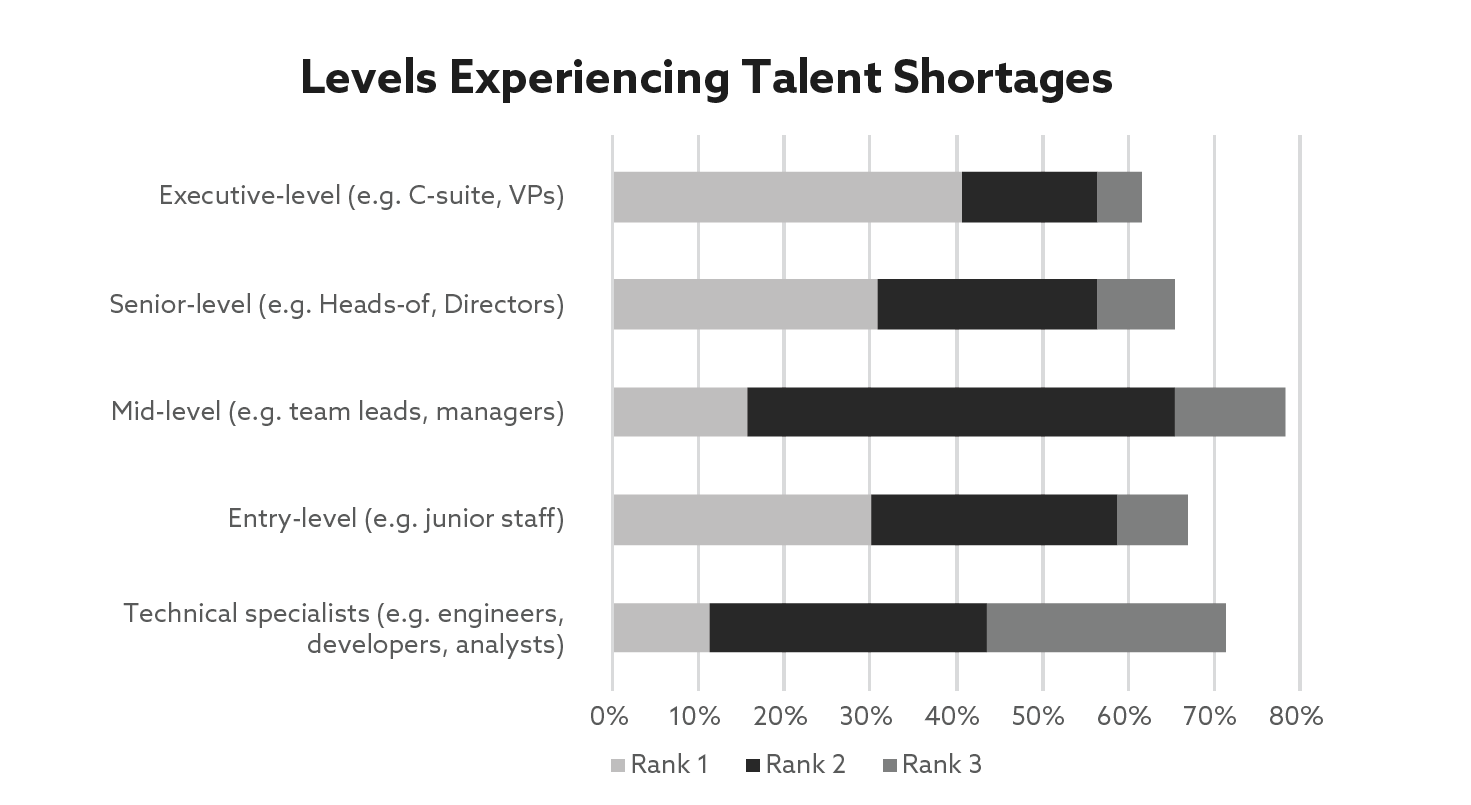
These challenges are therefore not limited to a specific function or level of seniority.
The breadth of these shortages points to a structural issue. When talent gaps exist across almost every organisational layer, it becomes difficult to argue that the problem lies solely within the external labour market. The question is therefore no longer simply where talent is missing, but why organisations struggle to build and retain the capabilities they need for sustainable growth.
Why Mid-Level Talent Has Become the Critical Bottleneck
One of the most revealing findings of the report is the pressure being experienced within the middle-management layer.
Team leaders, department managers, and experienced specialists play a pivotal role in modern organisations. They translate strategic decisions into operational action, coordinate teams, prioritise resources, and guide change initiatives on a day-to-day basis.
The report highlights this layer as a critical link between strategy and execution. When these roles remain vacant or become overstretched, a domino effect occurs. Senior leaders are forced deeper into operational matters, while frontline teams experience reduced lose guidance and coordination.
For many consumer businesses, this middle layer is becoming an increasing constraint. While senior leadership focuses on strategy and operational teams focus on delivery, the organisational layer connecting the two is often under-resourced.
Organisations Are Already Taking Action – Yet the Gaps Remain
Despite persistent talent shortages, consumer companies are far from inactive. Organisations have introduced a wide range of initiatives to strengthen their employer proposition and address capability gaps.
According to the European Business Resilience & Growth Report 2026, 59% of organisations are investing in upskilling and reskilling programmes. Fifty-seven percent have adopted flexible working models, while 43% are reviewing and adjusting compensation structures. A further 40% are using external recruitment support, and 26% are investing in employer branding and retention initiatives.
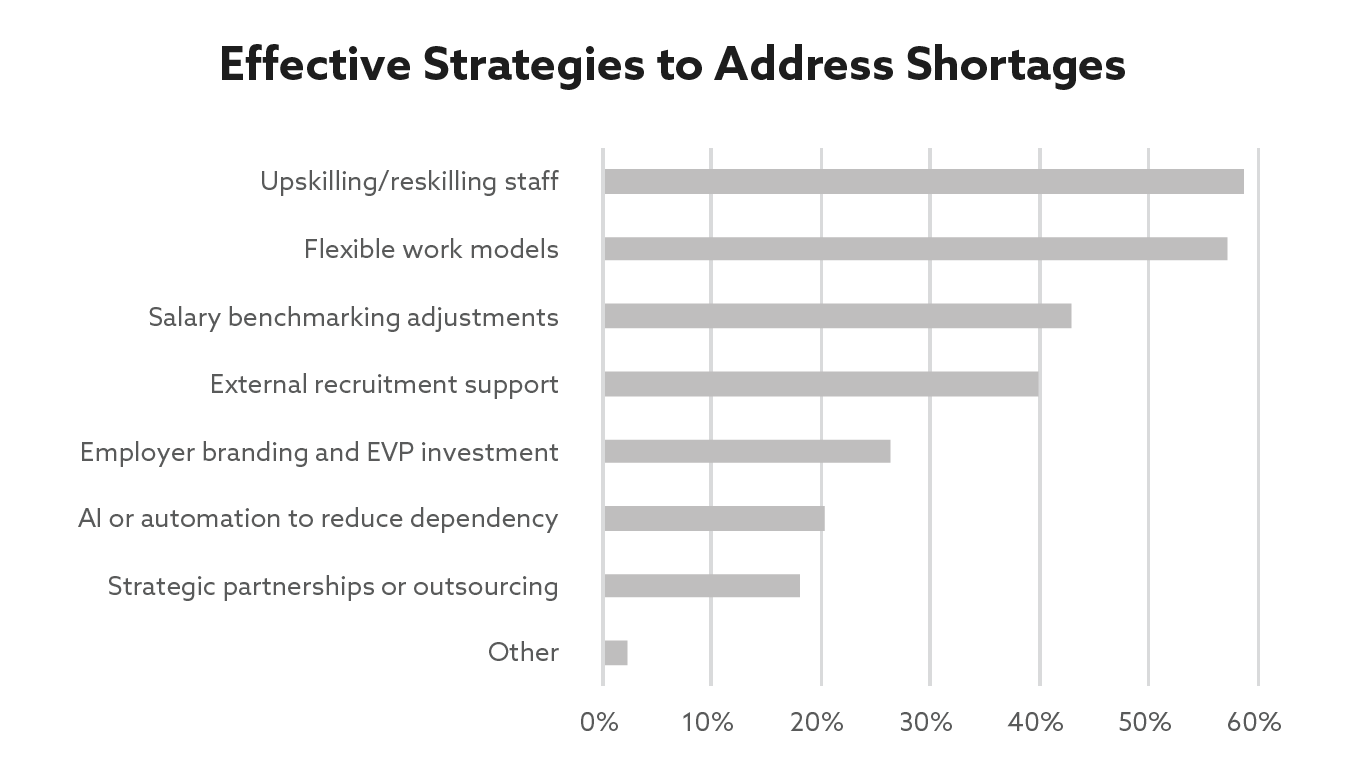
The data shows that organisations are already responding to the challenge. At the same time, it also demonstrates that even a broad mix of initiatives has not fully resolved talent shortages.
This raises an important question: if companies are already investing heavily in recruitment, compensation, flexibility, and workforce development, why do talent gaps persist?
Part of the answer may be that organisational requirements are evolving faster than the capabilities, structures, and leadership systems needed to support them. Talent shortages are therefore becoming less about finding candidates and more about an organisation’s ability to develop new skills, scale knowledge, and adapt successfully to change.
The Real Challenge: Building Capability for Transformation
One of the report’s key observations is that resilience is increasingly being sustained through continuous effort rather than through built-in reserves of capacity.
This is where the discussion moves beyond recruitment.
Many consumer businesses have achieved significant efficiency gains over recent years. Teams have been streamlined, processes optimised, and productivity improved. While these measures can strengthen resilience in the short term, they can also leave organisations with limited room to absorb additional change.
The consequences are increasingly familiar: greater dependence on key individuals, slower decision-making, and reduced flexibility. The organisation continues to operate, but often only through sustained personal effort from employees.
As a result, the central challenge shifts away from hiring alone and towards developing the capabilities required for future growth and transformation.
What Successful Organisations Are Doing Differently
The most successful organisations do not view talent as a standalone issue. Instead, they treat talent strategy as an integral component of organisational strategy.
Rather than focusing exclusively on filling vacancies, they invest in organisational design, leadership development, and internal mobility. They create greater role clarity, reduce complexity, and enable faster decision-making.
Particular attention is given to strengthening the middle-management layer, where both operational excellence and successful change execution largely depend.
At the same time, emerging technologies are fundamentally changing how organisations operate. The findings of the European Business Resilience & Growth Report 2026 show that artificial intelligence, automation, and data-driven decision-making are among the most significant drivers of organisational change. As organisations invest in new technologies, they are also reassessing the capabilities they will need in the future.
This is shifting the conversation away from simply filling open positions and towards understanding which skills will create long-term value. Organisations increasingly require not only technical expertise, but also digital fluency, adaptability, change leadership, and the ability to integrate technology effectively into existing business models.
Leading organisations are responding by aligning talent strategy more closely with capability building. They invest in developing new skills, support internal talent progression, and create structures that encourage continuous learning.
The focus therefore shifts from asking, “How do we find more talent?” to a more important question:
“How do we create an environment where capabilities can be developed, strengthened, and sustained over time?”
Conclusion: The Skills Gap Is About More Than Recruitment
The debate around talent shortages often overlooks the bigger picture. The findings of the European Business Resilience & Growth Report 2026 show that talent gaps are not confined to specific functions or levels of seniority. In particular, shortages in middle management highlight how dependent organisations have become on roles that connect strategy, change, and execution.
At the same time, companies are already investing in recruitment, workforce development, flexible working, and retention initiatives. Yet many challenges remain. This suggests that the solution does not lie in hiring alone.
For consumer companies, this requires a shift in perspective. Future talent strategies must be more closely linked to organisational development, capability building, and technological transformation. As artificial intelligence and automation continue to reshape the workplace, an organisation’s ability to develop new skills and continuously evolve its workforce will become a defining competitive advantage.
Companies that view the skills gap purely as a labour market issue are unlikely to solve it. Those that recognise capability building as a strategic priority will be better positioned to drive sustainable growth, strengthen resilience, and succeed in an increasingly complex business environment.